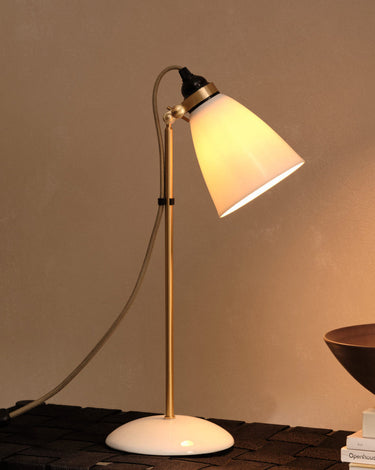
A designer who swapped plastic flex for cotton braid from the family iron, a pottery saved from closure in Stoke-on-Trent, and a little bone china dome that started it all. This is the story of Original BTC, and of how its lights are still made by hand in England.
Original BTC at a glance
- Founded in 1990 in Oxfordshire, England, by designer Peter Bowles
- Peter was the first designer to light a room through bone china; his Hector table light was the first light ever produced in it
- Owns its own bone china pottery in Stoke-on-Trent, plus glass and metal workshops in Oxfordshire
- Still independent and family-run, with Charlie and Hettie Bowles in leadership roles
- Shop the collection: Original BTC lighting at LoftModern
A dome of china, and a cable from the family iron
In the early 1990s much of the lighting trade was moving toward synthetic parts and mass production. Peter Bowles, who came from a family with a long history in making and design, set off the other way. He founded Original BTC in Oxfordshire in 1990 and went looking for a material nobody had thought to put a bulb behind: fine bone china.
The result was the Hector, one of his first designs. A small dome of translucent china on an adjustable stem, it showed what the material could do when light passed through it, and it went on to become the brand's best-known shape around the world. Even the cable had a story. Unhappy with the look of ordinary plastic flex, Peter replaced it with woven cotton braid, famously cut from the family iron. That braided cable is still an Original BTC signature today.

The pottery he would not let close
From the start, Peter wanted his shades made locally, and that meant Stoke-on-Trent, the old heart of English pottery since the 1700s. In 2002 he visited the factory that was casting his bone china and learned it was about to shut. He bought the business on the spot and kept every member of staff.
That pottery is now the company's lifeblood. It produces the china shades, bases and ceiling roses behind most of the best-loved designs, and Original BTC keeps investing in it, most recently with a new firing kiln. Many of the people working there have been with the company for years, each a specialist in one stage of the craft.
Six days, ten pairs of hands
Bone china is prized for three things: it is tough, it is brilliantly white, and it lets light through. Getting it into the shape of a lampshade is slow work. A liquid mix of clay and water, called slip, is poured into plaster moulds. Once it has set, the mould is split open, the shade is lifted out and left overnight to dry, then sponged and fettled by hand to remove every seam and blemish. Finally it goes into the kiln, either for a biscuit firing that leaves a soft matte surface, or dipped in glaze and fired again for a gloss finish.
Every piece passes through at least six pairs of hands along the way: casters, spongers and fettlers, kiln operators, glazers, foot wipers and painters. For the Hector, the brand puts the number at ten craftspeople over about six days. The film below, from Original BTC, follows a Hector shade from the first pour to the finished dome.

Painted, pierced and folded
Some designs go further. Certain shades are hand-painted or gilded by the pottery's master painters. The Alma, a collaboration with Swedish interior designer Beata Heuman, began with her visit to the Stoke factory; its shade has 41 holes made by hand, which she has likened to small stars when the lamp is lit, and it is hand-painted in seaweed, natural or coral.
Other pieces push the casting itself. The Hatton turns china into a crisp, faceted gem. The Fin has deep ribs that glow in bands. The Christie borrows its rippled rim from rolling waves. And the Blossom, the brand's first cordless light, pairs a fluted china shade inspired by plum blossom with an LED source engineered in Oxford by its sister company Beadlight.
Glass from Britain's last flat-glass maker
In 2011 Original BTC bought English Antique Glass, the last traditional flat-glass maker in the UK, and with it a team whose stained-glass panes have gone into landmarks such as York Cathedral and Buckingham Palace. The workshop first blew the thick, sea-going glass for the Davey Well Glass lights, then took on work for the whole range.
Every piece is gathered from the furnace, shaped, blown and finished by hand, which is why the glass has a gentle texture and the odd seed of air. Glass-blowing was brought together at the main Oxfordshire site in 2023, and any glass that does not pass inspection is melted down and blown again. You can see that glass in the Well Glass Pendant, the Ship's Well Glass Table Lamp and the opal globes of the Magnus range.

Brass, copper and a shipyard heritage
Bone china is only half the house. When Peter wanted to move into outdoor lighting, Original BTC took over Davey Lighting, keeping it in Britain rather than letting it go to a buyer who planned to move production abroad. Davey traces its roots to the London shipyards of the 1800s, which is why so many of its lights still look as if they belong on a deck: well glass lanterns, bulkheads, mast lights. Many are weather-rated and still made by hand in England.
In the same period a Birmingham metalworks with more than five decades of experience joined the company. In 2022 it moved to the Oxfordshire site, where its team solders, welds and shapes brass, copper and aluminium into shades, bases and fittings. For the solid metal pieces, including the Mast Light, a long-standing partner foundry in Birmingham still pours molten metal into packed sand moulds by hand, breaks the mould away and machines each casting to finish.

Still a family firm
Original BTC remains independent and privately owned, and it keeps design, making and distribution in-house. Peter's son Charlie grew up assembling Hector lamps as a teenager, designed his first light, the London, in 2009, and became a Director in 2012. His sister Hettie joined in 2017 to run operations and logistics. Along the way the company won a Queen's Award for Enterprise in International Trade in 2015 and opened showrooms in Paris and in New York's SoHo.
The family thinking shows in how the lights are meant to be kept. Around 95% of components are sourced in the UK, many from other family-run suppliers. Spare parts are sold so a lamp can be repaired rather than replaced, and recycled metal goes into many of the Davey lights. In 2020, for the company's 30th year, the Hector returned as the Hector 30 on a satin brass stem, made in the same Stoke factory where the first prototype was cast.

Meet the collection
Every Original BTC piece in this story is available to order directly from LoftModern:
- The Hector family: Hector Medium Dome Table Lamp, Hector 30 Table Lamp, Hector 30 Wall Light, Hector Size 3 Pendant, Hector Size 4 Pendant and the Hector Bibendum
- Cast in bone china: Alma Table Light and Alma Pendant, Christie Pendant, Hatton 3 Pendant, Fin Pendant and Fin Extra Large, and the cordless Blossom
- Hand-blown glass and cast metal: Magnus C4 Chandelier, Well Glass Pendant, Ship's Well Glass Table Lamp, Mast Light, Shipyard Pendant, Quad Pendant, Stanley Pendant and the Neo Sconce
See the full range in our Original BTC collection, or browse all pendant lights and table lamps.
Keep reading
- Original BTC at LoftModern: 12 bone china and brass lights in real rooms
- Plug-in or cordless wall sconces: which is better for renters?
- More maker stories: Michele De Lucchi and Produzione Privata and Humble's cordless lamps from Amsterdam
Frequently asked questions
Who founded Original BTC?
Designer Peter Bowles founded Original BTC in Oxfordshire, England, in 1990. The company is still independent and family-run, with his son Charlie and daughter Hettie in leadership roles.
Was Original BTC the first to make lights in bone china?
According to the brand, yes. Peter Bowles was the first designer to use bone china for lighting, and his Hector table light was the first light ever produced in the material.
Where are Original BTC lights made?
In England. The bone china comes from the company's own pottery in Stoke-on-Trent, and hand-blown glass and metal parts are made at its Oxfordshire site. Around 95% of components are sourced in the UK.
How long does it take to make a Hector shade?
The brand says each Hector passes through the hands of ten craftspeople over about six days: slip casting, drying, sponging and fettling, then firing in the kiln.
Sources: Original BTC, Heritage; Original BTC, Factories; Original BTC, About Us; Original BTC, Sustainability; Original BTC Journal, Hector 30; Original BTC product pages for Alma and Blossom. Photos and film courtesy of Original BTC.