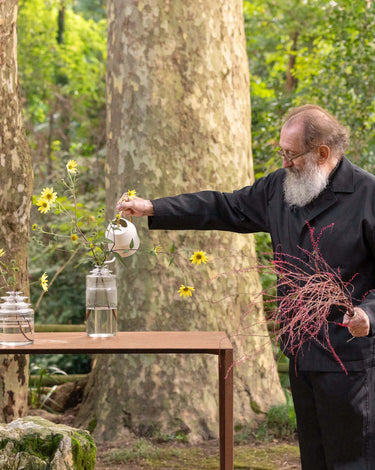
An architect who wanted the freedom to make things by hand, a pencil sketch from 1996, and the glassblowers of Murano. This is the story of Produzione Privata, and of the lamp that became its signature.
Produzione Privata at a glance
- Set up in 1990 by Michele De Lucchi, with his partner in the venture, Sibylle Kicherer
- Small-series objects made with Italian artisans, free of mass-production rules
- Workshops dedicated to Murano blown glass, borosilicate glass, bent glass, ceramics, metal and wood
- Signature lamp: Acquatinta (1996), mouth-blown on Murano; its first sketches are held by the Centre Georges Pompidou, according to the company
- Shop the collection: Produzione Privata by Michele De Lucchi at LoftModern
An architect who wanted a workshop of his own
Michele De Lucchi was born in Ferrara in 1951 and trained as an architect in Florence. In the 1970s and 1980s he was part of Italy's radical design groups, Studio Alchimia and Memphis among them, before going on to design lamps, furniture and offices for some of the best-known names in Italian industry. (Our stories on his Tolomeo, Castore and Ipno lamps cover that side of his career.)

Industry, though, has rules: large runs, tight costs, materials chosen for the machine. In 1990, as Memphis came to an end, De Lucchi and Sibylle Kicherer set up something different, partly to carry that Memphis spirit forward. They called it Produzione Privata, literally "private production": a small company where ideas could be developed free of industrial logic, using materials and techniques that big manufacturers had abandoned or not yet taken up. The very first pieces were made for De Lucchi's own small house in Milan, starting with a pear-wood bed in 1990.
It still works alongside De Lucchi's architecture studio, in the same spaces and with the same people. Each line has its own laboratorio, a workshop devoted to one material or idea: Murano blown glass, borosilicate glass, bent glass, ceramics, metal, wood, and two more experimental strands called Minimal Machines and Ready-made. The work is carried out by craftspeople in the parts of Italy where those skills are still alive.
From a pencil sketch to a wooden mold
Every Produzione Privata object begins on paper. De Lucchi draws constantly, in pencil, tempera and watercolor, and the Acquatinta pendant, which he designed with Mario Rossi Scola, started the same way, in a set of sketches in 1996. The earliest drawing still carried a decorative element. As the idea developed it fell away, leaving a cleaner, quieter form: a single blown diffuser shaped to hold the lamp holder inside it, and one form meant to become three lamps, each with its own character and kind of light.

The drawings went next to a woodworker, who turned the profile into a mold. On Murano, blown glass is shaped inside molds like this one, and the step from sketch to mold to first glass prototype is where a drawing becomes an object. One unusual decision stayed from the start: the lamp would show its working parts, the bulb and the cable, rather than hide them, something few lamps of the time did.

Made by the glassblowers of Murano
De Lucchi first worked with blown glass through Luciano Vistosi, a Murano glass artist who also ran a lamp factory. But he has said that his first true glass objects were the ones he designed for Produzione Privata, and the company is clear about who the main characters are: the glassblowers of Murano, the lagoon island where the craft has been practiced for generations.
The lamp's name is a tribute to them. Acquatinta refers to the colored waters of Murano, whose ripples gave the shade its gentle curves. No two shades come off the blowpipe alike, so lamps from the same series are close cousins rather than identical twins. Produzione Privata treats that as the point, not a flaw. As Sibylle Kicherer put it, "blown glass is thinner," and in the transparent version you see the pure material at its most striking.

The bilancino: a small rod that makes it hang true
Hand-blown glass brings one practical problem. Because every shade is made by hand, no two weigh exactly the same, and a pendant that is a few grams heavier on one side will hang crooked. The solution is a tiny piece of engineering called the bilancino, a "little scale." The suspension is fixed to a small metal rod, and its contact point is slid sideways until the lamp hangs perfectly level. It is easy to miss, and it is exactly the kind of detail that separates a crafted lamp from a decorative one.

One lamp becomes a family
Acquatinta became the company's most successful product, and it grew. In 1998 came the Acquaparete wall light, made by the same glassblowers with the same technique but with a narrower, longer glass shade carried on a painted gray arm. That arm lets the glass rotate through 180 degrees, so the light can be turned up for a soft glow or down for direct light.

A year later De Lucchi sketched Acquamiki, a smaller version of Acquatinta. Over the years the family has been tried in many surfaces, from clear, frosted and transparent green glass to black glass and mirrored "transmirror" finishes, and in 2016 a faceted Acquamiki Diamond in optical glass with a chrome fixture premiered at the Salone del Mobile in Milan.


Beyond the water lamps: lanterns, hats and lattices
The same way of working runs through the rest of the collection. The Perseo 15 sconce, part of a family launched in 2008 and named for the hero of Greek myth, is a bubble of satin Murano glass whose soft facets recall Japanese paper lanterns and the sculpture of Isamu Noguchi. The Chapeau, French for hat, turns to borosilicate, a glass De Lucchi values because it is industrial in origin yet can still be worked by hand; the Chapeau table lamp and Chapeau pendant set a wide white metal brim over the blown glass, turning the familiar recipe of glass shade on metal stand upside down: the metal now shades, and the glass carries a small spark of light on top. And the Trellise pendant grew out of De Lucchi's Ipy collection: borosilicate glass expanded by hand in the flame into a clean, slim shape.

Thirty-odd years on, the idea behind it all has not changed: draw by hand, find the craftsperson who still knows how, and let a small series carry the marks of the people who made it. For another side of De Lucchi's work in glass, read about his hand-blown Logico system for Artemide.
Meet the collection
You can order every lamp in this story directly from LoftModern:
- Acquatinta Murano Glass Pendant: the original 1996 water lamp
- Acquaparete Murano Glass Wall Light: the wall version with a rotating shade
- Acquamiki Diamond Mini Pendant: the small faceted pendant
- Perseo 15 Murano Glass Wall Sconce: the paper-lantern bubble
- Trellise Borosilicate Glass Pendant: flame-worked borosilicate in a slim form
- Chapeau Glass Pendant Light and Chapeau Glass Table Lamp: the wide-brimmed "hat"
See them all in our Produzione Privata by Michele De Lucchi collection, or browse every pendant light, wall sconce and table lamp we carry.
Keep reading
- Who is Michele De Lucchi?
- Michele De Lucchi for Artemide: Tolomeo, Castore and Ipno in real rooms
- Inside De Lucchi's hand-blown Logico lighting system
- More maker stories: how APE Amsterdam designed the Humble cordless lamp and Le Klint's hand-folded Danish lamps
Frequently asked questions
Who founded Produzione Privata?
Architect and designer Michele De Lucchi founded Produzione Privata in Italy in 1990 together with Sibylle Kicherer, as a small company for objects made with artisan techniques outside the logic of industrial production.
Who blows the glass for the Acquatinta lamp?
Glassblowers on Murano, the island in the Venice lagoon. Each shade is mouth-blown one at a time, which is why no two Acquatinta shades are exactly alike.
What does the name Acquatinta mean?
It pays tribute to the colored waters of Murano, whose ripples inspired the curves of the lamp.
What is the bilancino on an Acquatinta lamp?
A small metal balancing rod. Because every hand-blown shade has a slightly different weight, the suspension is attached to the bilancino and its contact point is adjusted until the lamp hangs perfectly level.
Where are Michele De Lucchi's Acquatinta sketches kept?
According to Produzione Privata, De Lucchi's first Acquatinta sketches from 1996 are part of the permanent collection of the Centre Georges Pompidou in Paris.
Sources: Produzione Privata on the birth of the Acquatinta family; Produzione Privata on borosilicate glass; Produzione Privata brand profile; Produzione Privata, About and history; Cooper Hewitt designer biography; Produzione Privata catalogue. Portrait of Michele De Lucchi courtesy of Produzione Privata. Film and photos courtesy of Produzione Privata (Luca Tamburlini / Polifemo Fotografia).