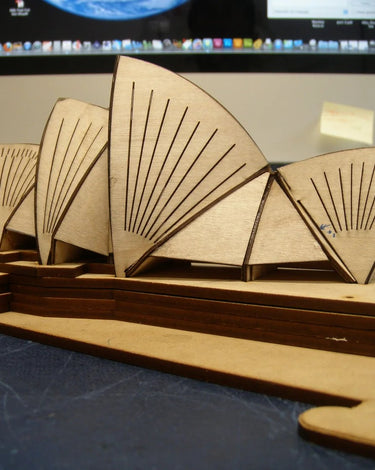
A boy who built dens from hay bales in the English countryside, an engineer and designer who worked his way from Japan to Brisbane, and a sewer pipe that needed unblocking on the day his first model went on sale in New York. This is the story of Marcus Bree and Little Building Co., and of how a great building becomes a box of timber parts.
Little Building Co. at a glance
- Architectural model kits designed, developed and manufactured in Brisbane, Queensland, Australia, by Marcus Bree
- First architect's model: the Solomon R. Guggenheim Museum, begun in 2008 and later a steady best seller in the Guggenheim's own store
- Kits are cut from timber, mainly aspen, American cherry and birch, with MDF and clear acrylic where a building needs glass
- Each sale supports the foundations, trusts and estates that look after the real buildings, according to Little Building Co.
- Shop the collection: Little Building Co. model kits at LoftModern
From hay-bale dens to a design career
Marcus Bree grew up in the English countryside, where winter meant skating on frozen ponds and the best building material to hand was a stack of hay bales. He likes to joke that snowball throwing offered few career prospects, so he turned to the thing he was good at: building.
He studied engineering and then three-dimensional design, and the work that followed took him to Japan, Hong Kong and the United States, then across Australia and finally to Brisbane, where he runs his own design company. He and his family live in an old Queenslander, the raised timber house of the region, which they are renovating a little at a time. Little buildings, he has found, are much easier to tinker with than big ones.

Little houses first
Making small houses felt like a natural extension of his love of making things and mixing textures and materials. The first range was the Australian Series: authentic 1:100 replicas of the houses you pass when you drive around Brisbane or Sydney, from colonial cottages and miners' cottages to terraces and two kinds of Queenslander. Little Building Co. keeps a library of reference photographs of the timber-and-tin houses of inner Brisbane and Sydney, and each kit is cut from timber and goes together with PVA wood glue and a little masking tape.

A Queenslander on a desk in New York
The jump to great architecture came by chance. One of his Queenslander Classic models found its way onto the desk of the head of business development at the Guggenheim Museum in New York. In 2008 Marcus began work on a model of Frank Lloyd Wright's spiral museum.
The design took six to eight months. Turning one model into a kit of parts that a stranger could build from printed instructions was a different problem, and so was costing and manufacturing a first order of 3,000 units, which he admits could have gone wrong very quickly. About three years later, the kit was on the shelf in the Guggenheim store. On the day it went on sale, Marcus was busy unblocking a sewer pipe choked by tree roots.
In its first week, he recalls, the little timber Guggenheim outsold the Lego version of the building 56 to 54. The Guggenheim kit has been refined over the years and, according to Little Building Co., has been a best seller for the museum store year after year.

Six years and a thousand photographs: the Opera House
After the Guggenheim, someone suggested he try the Sydney Opera House. Marcus had walked around it as a tourist but never given it the attention it deserved, and as far as he knew, in more than forty years nobody had produced a souvenir that did the building justice. He started in September 2011 without any idea how long it would take.
His reference shelf filled up fast: Philip Drew's book on the building, Yuzo Mikami's account of working in Jørn Utzon's studio, and Utzon's own competition drawings and reports held in the New South Wales State Records Office. He photographed every stage of his own work, thousands of plain record shots, because he often set off in one direction and changed course when a part refused to behave.
His method is patient and geometric. He breaks a building into modules and simple forms, works on all of them together so that what he learns on one carries to the next, and counts tiles and bricks in photographs to work out the true size of things. A single part might be cut and recut in steps of 0.1 or 0.2 millimeters until it fits. He began with the podium, because that is what the builders did first.

The shells took hundreds of hours. In theory they share one geometry; in practice every one is slightly different, and his first idea of shells that simply clipped together was soon abandoned because the curves and the timber fought each other. The more he learned, the more he found himself solving his problems in much the same way Utzon and his engineers had solved theirs.
Needing proof that anyone wanted the result, he turned to Kickstarter, pre-sold more than 120 kits and used the money to finish the work. It still took another 18 months to get a product ready for retail, nearly six years after he began. The film below, a stop-motion assembly Marcus made for that campaign, shows the Sydney Opera House kit building itself piece by piece.
Truth to materials
Marcus wants his models to look as if they came from the architect's own studio, and to have what he calls a truth to the materials they are made from. He avoids any process that changes the natural look of the timber, so the kits combine woods such as aspen, American cherry and birch with MDF, and use clear acrylic for glazing.
You can see the idea in every kit. The Farnsworth House pairs aspen and cherry with acrylic walls and even includes the black maple that once grew beside Mies van der Rohe's glass house. The Jacobs House, his first domestic building by Wright, uses cherry cladding to echo Wright's board walls and shows the brick laid to Wright's own system. The SC Johnson kit combines the Administration Building and the later Research Tower in 167 pieces.
Marcus is honest about his own taste. He prefers the clean approach of Mies to Wright's applied ornament, but he calls Wright a genius at planning and shaping space, and that is what his Wright models set out to capture. Little Building Co. works with the Frank Lloyd Wright Foundation on its Wright kits, including Unity Temple.

Made, checked and packed in Brisbane
Little Building Co. manufactures its own kits so that the attention to detail carries through every stage. It sources raw materials from sustainable sources where possible and inspects components constantly during production. Every kit ships in a sturdy box with stage-by-stage diagrams, and the company says the hard part, the research and the engineering, has already been done for you.
The builds are not meant to be difficult. You do not need to be a craftsperson, only willing to follow instructions. Some parts use a pressure-sensitive adhesive that cures over time, so a piece placed in the wrong spot can be peeled off and moved. Once finished, a coat of furniture wax protects the timber; the one exception is the Farnsworth House, whose acrylic walls should be left unwaxed.
Meet the collection
Every Little Building Co. kit in this story is available to order directly from LoftModern:
- Frank Lloyd Wright: Solomon R. Guggenheim Museum, Unity Temple, Jacobs House and the SC Johnson Administration Building and Research Tower
- Mies van der Rohe: Farnsworth House
- Jørn Utzon: Sydney Opera House
- Giles Gilbert Scott and Herzog & de Meuron: Tate Modern
See the full range in our Little Building Co. collection.
Keep reading
- Why sculptural objects are more than decor
- How do I style a shelf with design objects and wooden figures?
- More maker stories: Boyhood's oak figures from Aarhus and Graypants and its recycled cardboard lamps
Frequently asked questions
Who founded Little Building Co.?
Marcus Bree, an engineer and three-dimensional designer who grew up in the English countryside and settled in Brisbane, Australia, after working in Japan, Hong Kong and the United States. The company trades as Bree Industries.
Where are Little Building Co. kits made?
The kits are designed, developed and manufactured by Little Building Co. in Brisbane, Queensland, which inspects components throughout production.
How long did the Sydney Opera House model take to develop?
Marcus started in September 2011. Counting the Kickstarter campaign that pre-sold more than 120 kits and the 18 months of production work afterwards, it took close to six years to reach retail.
Why are the models made of timber instead of plastic?
Marcus wants each model to look like an architect's working model and to stay true to its materials, so he works in natural timbers such as aspen, cherry and birch and avoids anything that alters their natural appearance.
Does buying a kit support the real buildings?
According to Little Building Co., purchases support the foundations, trusts and estates that preserve and protect the legacy of the architects, and its Wright kits are developed in association with the Frank Lloyd Wright Foundation.
Sources: Little Building Co., About Us; Solomon R. Guggenheim Museum, Model Development; National Opera House, Model Development; Little Building Co. home page; Little Building Co. model pages and FAQ. Photos and film courtesy of Little Building Co.