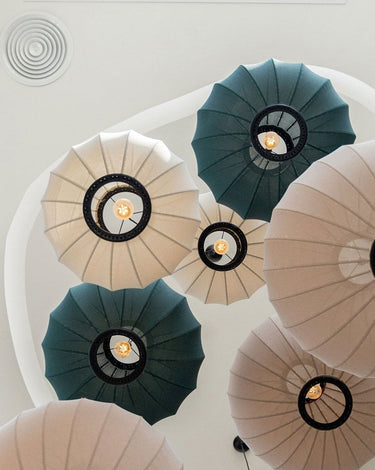
A brand that owns no factory, a family knitting mill in the Austrian countryside, a 1951 lamp drawn for craftsmen, and a handful of Copenhagen designers who like soft materials. This is how Made by Hand lamps are designed, and who actually makes them.
Made by Hand at a glance
- Danish design brand founded in Copenhagen in 2014 to develop durable design objects made by skilled craftspeople, in Denmark and abroad
- Designers behind the lamps we carry: Iskos-Berlin (Knit-Wit), Boris Berlin (Flying), Aleksej Iskos (Mollis), Kim Richardt (RO), Nina Bruun (Papier), A. Wedel-Madsen (Workshop) and Groundwork Studio (Fuse)
- Crafts in the collection: 3D knitting, hand-wound jute yarn, rice paper on a welded frame, spun and pressed metal, opal glass with alabaster and brass
- Knit-Wit and Flying shades are 3D knitted in Austria by Kobleder, a third-generation family company, with no knitting waste
- Shop the collection: Made by Hand lighting at LoftModern
A brand built around other people's hands
Made by Hand was founded in Copenhagen in 2014 with a simple idea: develop new design objects that last, and have them made by local craftspeople who know their material better than anyone. The company does not run a single factory. Instead it works with a network of workshops in Denmark and abroad, and it treats those makers as partners in the design, not suppliers at the end of it.
That is also how the name should be read. Each lamp begins with a designer, but it only becomes a product after months of prototypes with the people who will make it: testing shapes, materials and how the light behaves, often using traditional methods. The brand says it respects the time each process takes, and the collection shows it. Almost every family uses a different craft.
Knit-Wit: the lamp nobody had knitted before
Knitting is one of the oldest crafts there is, yet in 2016, when Made by Hand started exploring it, nobody was using it for modern design lamps. The brand wanted a knitted shade that was both beautiful and a good light, and it went looking for a maker that could do it at scale.
It found one in the Austrian countryside: Kobleder, a family business now in its third generation, with long experience in knitting production. After several years of shape studies and knitted prototypes, Kobleder's engineers and technicians helped the designers solve the knitting itself. The result was Knit-Wit, a seamless 3D-knitted shade in flame-retardant yarn that spreads light through the pattern of the stitches. Each shade comes off the machine in its final shape, so the knitting produces no waste.
The designers are Iskos-Berlin, the Copenhagen studio of Boris Berlin and Aleksej Iskos, founded in 2010. The two first worked together at Komplot Design, where Berlin was a co-founder and Iskos spent more than eleven years as his assistant. Work from their studios is held by design museums including the Designmuseum Denmark, Die Neue Sammlung in Munich, the Vitra Design Museum and the Museum of Modern Art in New York.

The film below, made by Made by Hand, goes to Kobleder's mill and follows the yarn from the cones to the finished shade.
Flying: stretching the knit as far as it goes
When Made by Hand asked Boris Berlin for a large, sculptural lamp series in 2023, he went back to everything the team had learned on Knit-Wit and pushed it further. In Flying, the knitted fabric is stretched between a wavy aluminum frame and a centerpiece that holds top and bottom apart. Hung in a room, the biomorphic shape seems to hover, which gave the lamp its name.

The LED light source sits in the top, so the light is diffused softly through the knitted lower half. Flying is knitted by Kobleder too, and it ships flat-packed in cardboard to cut the space it takes up in transport. Berlin, also a founding partner of Komplot Design and his own Boris Berlin Design, likes to describe design as storytelling that reveals the essence of an object.

Mollis: a lamp wearing a sweater
Aleksej Iskos, who grew up in Ukraine and studied at the Royal Danish Academy of Fine Arts, opened his own studio, Iskos Design, in 2018. His Mollis pendant came from an everyday thought: knitwear is something we dress in, so why not dress a lamp in it? The knitted shade is pulled over a metal frame much like a pullover, which keeps the construction simple and the material use low. It also means the shade can be taken off to be washed or replaced.

Most of the LED light is aimed downward, while the knit softens what spills to the sides. The name is Latin for soft, a word that covers both the material and the light.

RO: jute yarn and an old Danish habit
Kim Richardt trained as a blacksmith and taught himself design. A fascination with classic Danish furniture led him to open a vintage furniture shop in central Copenhagen, and it was from the workbench in that shop that he drew the RO series.

RO looks back to the 1920s and 1930s, when Danes made simple lampshades by tying yarn around a wooden stand. Richardt's version winds natural jute yarn around a plain frame in the same spirit. In Danish, ro means calm, the quiet feeling of being at ease.

Papier: rice paper, one piece at a time
Nina Bruun holds a master's degree in furniture and spatial design from the Royal Danish Academy of Design. She has a Red Dot Design Award, work in the permanent collection of the Museum of Arts and Design in New York, and a second career as a consultant on interior trends and color.

Her Papier family is built from soft curves. She repeated, distorted and refined a few base shapes until they felt right together. The making is slow: a frame is pre-bent to each design, welded and painted, and then the rice paper is attached piece by piece. The paper gives a light, almost floating look and spreads the light evenly through its texture and translucency.

Workshop: a 1951 lamp made for people who make things
The oldest design in the collection is also the plainest. A. Wedel-Madsen drew the Workshop lamp in 1951 to give craftspeople the light they needed at the bench. In 2026 Made by Hand marked its 75th year with an anniversary edition that adds a solid brass top and three new colors.

The lamp is still made in Denmark, by metalworkers in the countryside who use both traditional tools and modern machines. In the short film below, a metalworker who first made these lamps some 50 years ago shows the process and explains that small irregularities where the work starts and stops are simply part of making something by hand. Today the Workshop hangs everywhere from a new Copenhagen public school to the H.C. Ørsted Institute, a university building constructed between 1955 and 1962, where the W4 appears in a custom glossy black.

Fuse: brass, opal glass and alabaster
The newest family comes from Groundwork Studio, which industrial designer Morten Bo Jensen founded in Copenhagen in 2022 after sixteen years as in-house chief designer at a leading Danish brand. Fuse was first shown at the 3 Days of Design festival in Copenhagen in June 2025.
The name describes the key detail: a solid brass part that reaches out to hold the glass shade and seems to merge with it. The shade itself is three-layer opal glass for a wide, soft spread of light, and the bulb sits behind a translucent lid of natural alabaster, so you never look straight into it over a bed or a dining table. Jensen has said a lamp spends much of its life switched off, so it has to look good dark as well as lit. That is the reason for the brass, the glass and the stone.


Meet the collection
Every Made by Hand lamp in this story is available to order directly from LoftModern:
- Knit-Wit by Iskos-Berlin: pendants 45, 60, 65 and 75, the LED pendants, the Oval pendants, the Oval ceiling and wall lamps and floor lamps such as the Floor Level 60 and High Floor 45
- Flying by Boris Berlin: 58, 78 and 96
- Mollis by Aleksej Iskos: 20" and 26"
- RO by Kim Richardt: table 15 and 23, floor 30, and pendants 15, 23 low, 23 high and 30
- Papier by Nina Bruun: single pendants 40, 52 and 80, the Double 40 pendant and the Double table lamp
- Workshop by A. Wedel-Madsen: W2, W3 and W5
- Fuse by Groundwork Studio: Triple pendant, Single wall, Double wall and Portable
- Also from Made by Hand: the Copenhagen pendant and the small glass Colomina 9 and Colomina 16 pendants by AHM x LUND
See the full range in our Made by Hand collection.
Keep reading
- What is Japandi lighting?
- 10 Made by Hand fixtures that make a home feel calm
- More Danish maker stories: Le Klint's hand-folded lampshades and Boyhood's oak figures from Aarhus
Frequently asked questions
Who founded Made by Hand, and where is it based?
Made by Hand is a Danish design brand founded in Copenhagen in 2014. It develops lamps and other design objects with independent designers and has them produced by specialist workshops in Denmark and abroad.
Who designed the Knit-Wit lamp?
Knit-Wit was designed by Iskos-Berlin, the Copenhagen studio of Boris Berlin and Aleksej Iskos. Berlin later designed the Flying pendants, and Iskos designed Mollis on his own.
How is a Knit-Wit shade made?
It is 3D knitted from flame-retardant yarn by Kobleder, a third-generation family knitting company in Austria. The shade is knitted directly to its final shape, so there is no waste from the knitting.
How old is the Workshop lamp design?
A. Wedel-Madsen designed it in 1951 as a work light for craftspeople. Made by Hand still has it made in Denmark and released a 75th anniversary edition with a brass top in 2026.
Sources: Made by Hand, About; Made by Hand, Designers (Iskos-Berlin, Boris Berlin, Aleksej Iskos, Kim Richardt, Nina Bruun, Axel Wedel Madsen, Groundwork Studio); Made by Hand, Stories (Fuse at 3 Days of Design 2025, Workshop at the H.C. Ørsted Institute). Photos and films courtesy of Made by Hand.