
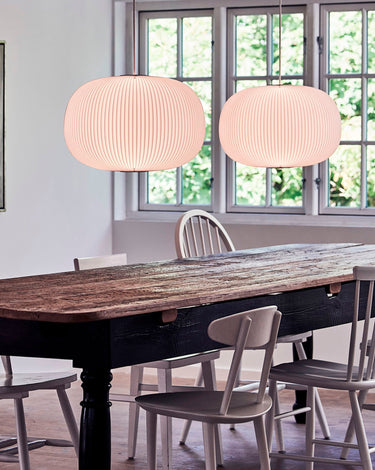
Short answer: Japandi lighting is the lighting side of Japandi style, a blend of Japanese minimalism and Scandinavian functionalism. It means warm, soft, diffused light from shades made of natural materials such as paper, wood and fiber, kept low and layered rather than bright and overhead. In a small apartment, one sculptural paper pendant, a wood-accented table lamp and plenty of empty space get you most of the way there.

What is Japandi, exactly?
Japandi is a portmanteau of "Japanese" and "Scandinavian." The Danish Architecture Center describes it as a fusion of Scandinavian functionalism and Japanese minimalism: calm, uncluttered rooms, a few well-made pieces, natural materials like grained wood and stone, soft muted colors, and a focus on craft over decoration. Both traditions care deeply about light, so lighting is where the style really comes alive.
The principles of Japandi lighting
- Warm, never harsh. Choose warm white bulbs. Color temperature is measured in kelvin (K); warm white runs roughly 2000K to 3000K, with 2700K the cozy everyday choice. Cooler, bluer light fights the calm of the style.
- Diffused, not pointy. Light should glow through a shade, not blast from a bare bulb. Paper, pleats and fiber soften it beautifully.
- Natural materials. Paper, wood, fiber, ceramic and recycled cardboard feel at home. Think texture you want to touch.
- Pleats and handwork. Folded, braided or layered shades bring the craftsmanship both cultures love, and they cast lovely shadows.
- Low and layered. Light sits closer to where you live: a pendant dropped over a table, a lamp on a low console, a floor lamp beside a chair. Several soft sources beat one bright ceiling light.
- Room to breathe. Negative space is a design element. One great lamp in an uncluttered corner says more than five in a crowded one.
How to get the Japandi look in a small apartment
- Pick one hero pendant. In a small space, a single sculptural paper pendant over the dining table or in a living-room corner sets the whole mood.
- Scale it to the room. Smaller sizes (around 20 in or less) suit compact dining nooks; larger shades suit open living areas.
- Add one wood note. A table lamp with a wood base ties the lighting to your furniture.
- Edit the surfaces. Clear the table where the lamp sits. The lamp is the decor.
- Keep the palette quiet. White, natural, oak and black read Japandi; save bold color for one accent.
Japandi lighting picks
Le Klint Model 101 Pendant

Designed by Kaare Klint in 1944 and made in Denmark, the Model 101 is the pleated pendant many people picture when they hear "Scandinavian lamp." Its shade is hand-folded, a craft Le Klint still practices in Odense. The folds diffuse light into a soft, layered glow that feels right at home in a Japandi room. Wired for 120V.
Le Klint 375 Table Lamp Small, Light Oak

A pleated shade designed by Esben Klint in 1942 on a light oak base: pleats plus wood, the Japandi formula in one lamp. The small size fits a nightstand or a narrow console.
Le Klint Lamella 1 Pendant

Designed by Hallgeir Homstvedt and Jonah Takagi in 2014, Lamella 1 brings a more contemporary, layered silhouette for those who like their Japandi a little more graphic.
Mammalampa The Bride Pendant, S and M

Hand-braided paper, made by hand in Riga, Latvia. The Bride is texture you can see from across the room. Choose the S (19.7 in) for a dining nook or the M (23.6 in) for a living room. Want it at floor level? The Bride Floor Lamp M sets a 23.6 in shade on a brass and steel tripod, 67 in tall.
Graypants Bell and Disc Pendants


Made from recycled cardboard, the Bell and Disc wear their layered cardboard edges proudly. Warm, earthy, and a great story to tell guests.
Graypants Barro Pendant

Created with Caterina Moretti of Peca, Barro pairs a wood-fired clay body from Oaxaca, Mexico, with a blown-glass shade: an earthy, handmade feel with a cleaner edge, great over a kitchen counter.
Japandi lighting checklist
- Warm white bulbs, around 2700K
- At least one shade in paper, fiber or another natural material
- One touch of natural wood (a lamp base, or the table under it)
- Light at more than one height: pendant, table and low
- No bare, glaring bulbs in your sightline
- A quiet palette: white, natural, oak, black
- Clear space around your hero lamp
Frequently asked questions
What is Japandi lighting?
Japandi lighting is warm, soft, diffused light from fixtures made of natural materials such as paper, wood and fiber, arranged low and in layers. It draws on Japanese minimalism and Scandinavian functionalism.
What is the difference between Japandi and Scandinavian lighting?
Japandi borrows Scandinavian functionalism and adds Japanese minimalism. In practice, that means the same practical, well-made lamps, styled with a quieter palette, more natural texture and more empty space around each piece.
What light bulb color is best for Japandi style?
Warm white, around 2700K. Lower kelvin numbers look warmer and more golden; higher numbers look cooler and bluer, which can feel stark in a Japandi room.
Do paper pendant lights work in a small apartment?
Yes. Choose a size that fits the space, such as the Mammalampa The Bride S at 19.7 in for a dining nook, and let it be the main decorative piece in the room.
Can I get the Japandi lighting look in a rental?
Yes. Start with plug-in pieces like a table lamp or a floor lamp, such as the Le Klint 375 or The Bride Floor Lamp, and use warm white bulbs. Ask your landlord before installing any hardwired pendant.
Need help picking? Ask us — we reply fast.