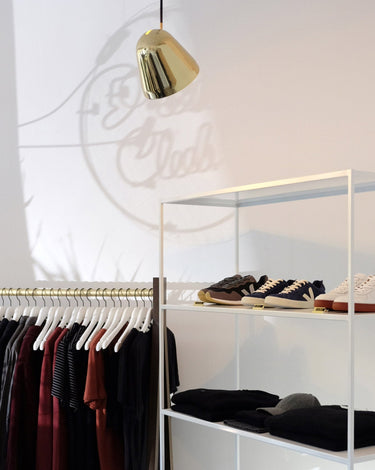
Two product designers, an architect who plans light for a living, and one lampshade you can turn in your hand. This is how Nyta began in Karlsruhe, and how its Tilt lamps are still designed in-house, made in Europe and largely finished and assembled by hand today.
Nyta at a glance
- Lighting label founded in 2012 in Karlsruhe, Germany, by Johannes Müller, Johannes Marmon and Fabian Maier
- Tilt is the lamp the company grew from; Nyta designs and develops almost all of its products in-house
- Almost every Nyta design is developed in-house; parts come from European partners and most lamps are finished and assembled by hand
- Honors listed by Nyta include the Good Design Award (Chicago) and the German Design Award, both in 2015
- Shop the collection: Nyta adjustable lighting at LoftModern
Three founders and one lamp
Nyta UG was founded in Karlsruhe in 2012 by Johannes Müller, Johannes Marmon and Fabian Maier. Two of the three, Müller and Marmon, are designers; Maier is an architect and lighting planner. In an interview with Germany's Design Center Baden-Württemberg, Müller called that mix an ideal team.

The founders had just graduated and were full of ideas for lamps they wanted to launch under their own control. The first was Tilt, which the Design Center describes as the nucleus of Nyta.

The idea: a reflector you steer by hand
Most pendant lamps decide for you where the light goes. Tilt hands that decision back. Its shade has a long, oblong opening cut into one side, and the whole shade turns and swivels around the bulb along that slot. Nyta compares it to a cupped reflector: it gathers the light and sends it toward the table, the wall or the object you want lit. The large Tilt tilts up to 110 degrees and rotates all the way around.
There is nothing to set but the shade itself: you simply take hold of it and move it, which is what Nyta means when it calls the handling easy and intuitive. A self-fastening hanging mechanism holds the lamp cleanly in position on its cloth-covered cord.

Who does what in the studio
Nyta's own description of the team reads like a well-balanced design office. Johannes Müller runs the company as managing director and sits in on every design process, from product to graphics, keeping the whole picture in view. Johannes Marmon is, in Nyta's words, the light specialist: he has been fascinated by light as a physical phenomenon, an aesthetic object and a function since his student days, and he chases new technologies and materials to turn them into lamps.
Fabian Maier, the third co-founder, is an architect and lighting planner. Designer Tina Schmid shapes colors, surfaces and the look of the brand, from photography to trade-fair stands. Nyta says almost all of its products are designed and developed in-house, with an occasional outside designer invited in.
From one lamp to a family
Tilt became the nucleus of the company. It first took off in Scandinavia, through a distribution partner specializing in that market, and today it is available in Japan, the United States, Australia, Mexico and Germany, among other markets. The same idea now comes as a pendant, a wall light and a floor lamp, and with a round shade as well as the original cone.
That round version is Tilt Globe. The sphere is smaller, about 20 cm across against 28 cm for the large Tilt, and the slot lets it tilt even further, up to 125 degrees. On the wall it becomes the Tilt Globe wall light, held out on a polished stainless steel tube with a toggle switch at its base.

Made in Europe, finished by hand
Nyta does not chase mass production. The company told Germany's Design Center Baden-Württemberg that it buys parts from European partners in regular, medium-sized runs rather than in bulk lots shipped from far away. That keeps quality control close and lets the team adjust details quickly, and it allows customized versions for contract projects, such as the custom-colored Tilts at Chrono24 in Nyta's home city.
Most lamps are largely finished and assembled by hand. The shades are solid metal, aluminum in matte white, grey or black, or solid brass, and they hang from a cloth-covered cord. Nyta describes its design language as very reductive, but always with finely crafted details.

The brass shade, polished until it glows
The brass versions show the handwork most clearly. Before a Tilt Brass leaves the workshop, each shade is polished by hand until the metal takes on a soft, warm shine. Tilt Globe Brass comes in the same polished solid brass, so the sphere reflects the room around it. In Nyta's short film below, you can watch a brass shade being polished.

Small company, long shelf of honors
Nyta has stayed deliberately small and independent, preferring a niche to the mass market. Even so, its list of recognitions is long: a FORM prize in 2012, the Formland Upgraded Design Award in 2013, the Good Design Award in Chicago and the German Design Award in 2015, a Platinum Prize at the European Product Design Award in 2018, Best of Best at the Iconic Awards in 2023 and first prize in the Architects' Choice category of the Best of Interior Awards in 2024. Tilts now hang in homes, offices, cafés and hotels from Iceland to Kyoto.
Meet the collection
Every Nyta lamp in this story is available to order directly from LoftModern:
- The original cone: Tilt Large in matte black, white or grey and Tilt Large in solid brass
- The sphere: Tilt Globe in matte black, white or grey, Tilt Globe in solid brass and the Tilt Globe wall light
- For groups of pendants: the Multiple Canopy, which hangs three or five Tilts from a single ceiling plate
See the full range in our Nyta collection, or browse all pendant lights.
Keep reading
- The art of layered lighting: a designer's guide to every room
- What is Japandi lighting, and how do you get the look?
- More maker stories: how Peter Bowles built Original BTC and Le Klint's hand-folded Danish lamps
Frequently asked questions
Who designed the Nyta Tilt lamp?
Nyta's Tilt page names no individual designer, and the company says almost all of its products are designed and developed in-house. Tilt was the first lamp of Nyta, founded in Karlsruhe in 2012 by designers Johannes Müller and Johannes Marmon and architect and lighting planner Fabian Maier.
Where is Nyta based?
Nyta is based in Karlsruhe, in south-west Germany. It was founded there in 2012, and its lamps are made in Europe with long-standing partners.
How does the Tilt shade work?
The shade has a long opening on one side and turns around the bulb along that slot, like a cupped reflector moving around the light source. You aim the light simply by moving the shade, and a self-fastening hanging mechanism holds the lamp cleanly in position.
How is the Tilt Brass finished?
Nyta polishes each solid brass Tilt shade by hand before it leaves the workshop, refining the surface until the brass takes on a soft, warm shine.
What is the difference between Tilt and Tilt Globe?
Tilt is the original cone-shaped shade, about 28 cm across, and tilts up to 110 degrees. Tilt Globe is a smaller sphere, about 20 cm across, that tilts up to 125 degrees and also comes as a wall light.
Sources: Nyta, About; Nyta, Tilt and Tilt Globe; Nyta, Projects; "Design Stories: Nyta," Design Center Baden-Württemberg; Nyta on Instagram. Photos and film courtesy of Nyta; project photographers credited in captions. Portrait of Johannes Marmon and Johannes Müller courtesy of Nyta.