
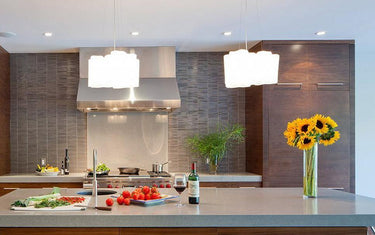

Artemide Logico is a family of hand-blown glass lights designed by Michele De Lucchi and Gerhard Reichert in 2001, built on one modular diffuser shape that can hang alone, mount to a wall or ceiling, sit on a table, or stack into clusters of three. Twenty-five years on, it remains one of the clearest answers to a question every interior eventually asks: how do you make a single light feel like part of the architecture?
LoftModern has mentioned Logico in passing before. This is the full study: where the shape comes from, how the system works, which formats suit which rooms, and why it has outlasted two decades of lighting trends without a single redesign of its core form.
The Designers: An Architect's Logic Applied to Glass
Michele De Lucchi came to lighting through architecture and the radical design movements of 1980s Milan, including Memphis. By the time he partnered with Gerhard Reichert on Logico, his work with Artemide already included the Tolomeo, a lamp so rational it became the reference point for the desk lamp itself. Logico applies that same rigor to a softer material.
The brief the pair set themselves was not "design a beautiful shade." It was closer to "design a system of light diffusion": one form, repeated and rotated, that could grow from a single bedside lamp to a sculptural ceiling composition without ever looking like a different product. The name says it plainly. Logico is Italian for logical.
The Shape: Positive and Negative Curves
Look closely at any Logico diffuser and you will see it is not a simple cone or dome. The hand-blown glass forms a soft, irregular volume, curving outward and inward in turn. Artemide describes it as a play of positives and negatives, and that is what makes the system work. Because the curves interlock visually, three diffusers can be nested on a triangular frame or set in a straight line and still read as one deliberate object.
Each piece is mouth-blown and finished by hand, with the lower edge cut clean with a diamond blade. That cut is what gives Logico its crisp silhouette against the softness of the glass. Two glass finishes define the mood:
- Silk: a satin white glass that turns the whole diffuser into an even, milky glow. Calm, gallery-like and easy to place anywhere.
- Grey Smoke (Fumè): a tinted glass that reads almost charcoal when off and warm amber when lit. More atmospheric, and a strong choice against dark walls, stone or walnut.
Frames and canopies are die-cast aluminum, and the collection is made in Italy.
Three Sizes, One Language
Logico scales in three steps, so you can carry a single design language from a powder room to a double-height living space:
- Micro, about 7 inches across: for small baths, walk-in closets, hallways and clusters where a light touch is needed.
- Mini, about 11 inches across: the most versatile size for bedrooms, kitchens and reading corners.
- Standard, about 15¾ inches across and 12¾ inches tall: the statement scale for living rooms, entries and dining spaces.
The Collection at LoftModern
Logico Single Ceiling Light

The Logico Single Ceiling Light is the purest expression of the idea: one standard-size diffuser mounted close to the ceiling. It solves the problem of the low-ceiling room, where a pendant would crowd the space but a flat fixture would feel anonymous. It takes a standard E26 bulb and dims on a standard phase-cut dimmer.
Logico Mini Table Lamp

The Logico Mini Table Lamp lifts the diffuser onto a slender stem, so the glass seems to float. On a nightstand or a console it gives soft, enveloping light with no glare, which is why designers return to it for primary suites and hotel rooms. For a bigger surface, the Logico Table Lamp in Grey Smoke brings the full-size diffuser and the warmer tinted glass.
Logico Single Pendant in Grey Smoke

Hung on its own, the Logico Single Pendant in Grey Smoke is a quiet sculpture. Hung in a row of two or three over an island, it creates rhythm without the visual weight of a linear bar. The smoked glass is especially good in kitchens with dark cabinetry or stone counters.
Logico Triple Linear Suspension
The Logico Triple Linear Suspension places three standard diffusers side by side on a single bar. This is where the positive-and-negative curves earn their keep: the three shapes overlap visually and read as one continuous form. It is our recommendation for long dining tables and conference tables.
Logico Triple Nested Formats

In the nested versions, three diffusers are set at 120 degrees around a central point, forming a compact, almost floral cluster. The Logico Triple Nested Pendant suits round dining tables, stairwells and entries. For lower ceilings, the Logico Mini Triple Nested Ceiling Light brings the same composition flush to the ceiling.
Logico Micro

At about 7 inches wide, the Logico Micro Single Ceiling Light brings the full design into the smallest rooms. Use a series of them down a corridor and the hallway becomes a sequence of soft glowing forms instead of a row of downlights.
Practical Questions
What is the difference between Logico Silk and Grey Smoke?
Silk is a white satin glass that diffuses light evenly and suits almost any palette. Grey Smoke is a tinted glass that looks dark when off and casts a warmer, moodier glow when lit. Choose Silk for brightness and calm, Grey Smoke for atmosphere and contrast.
Which Logico size should I choose?
Match the size to the room's scale. Micro (about 7 inches) suits closets, small baths and hallways. Mini (about 11 inches) is right for bedrooms, kitchens and reading corners. Standard (about 15¾ inches) belongs in living rooms, entries and over dining tables.
Is Logico dimmable?
Yes. The ceiling and pendant versions we carry take standard E26 bulbs and work with a compatible phase-cut dimmer when you use a dimmable LED bulb. Check each product page for the exact bulb and control details before ordering.
Can I mix Logico formats in one home?
That is what it was designed for. Because every piece uses the same diffuser shape, a Micro in the hall, a Mini table lamp in the bedroom and a Triple Linear over the dining table read as one coordinated scheme.
How do I clean hand-blown Logico glass?
With the power off and the glass cool, dust with a soft microfiber cloth. For a deeper clean, remove the diffuser and wash it by hand in lukewarm water with a little mild soap, then dry it fully before refitting. Avoid abrasive cleaners, which can mark the satin finish.
Why Logico Is Worth It
It is a system, not a single lamp. Buying into Logico means every future room can share the same design language at the right scale.
The craft is visible. Mouth-blown glass and a diamond-cut edge give each diffuser small variations you can see up close. That is the difference between a design object and a mass-produced copy.
It has already proven it lasts. Twenty-five years in production with its core form unchanged, Logico is one of the rare fixtures you can buy knowing it will not look dated in five years.
It works for homes and for projects. The same formats that suit a primary suite also light hotel corridors, restaurants and boardrooms, which is why architects specify it again and again.
How Logico Changes a Room
Most ceiling lights are noticed only when they fail. Logico is noticed when it is on and when it is off. By day the glass reads as sculpture; by evening the diffuser becomes the light itself, a soft volume rather than a hard point. The room feels composed, the ceiling feels considered, and the light flatters faces and materials alike. That is the quiet power of good design: it leads, and everything else follows.
Explore Artemide Logico
- Shop the full Artemide Logico collection
- Logico Single Ceiling Light
- Logico Mini Table Lamp
- Logico Table Lamp, Grey Smoke
- Logico Single Pendant, Grey Smoke
- Logico Triple Linear Suspension
- Logico Triple Nested Pendant
- Logico Mini Triple Nested Ceiling Light
- Logico Micro Single Ceiling Light
- All Artemide lighting at LoftModern
Be First to See What Leads
Join the LoftModern list for new Artemide arrivals, designer profiles and the pieces architects are specifying right now. Sign up with your email in the newsletter box at the bottom of this page.