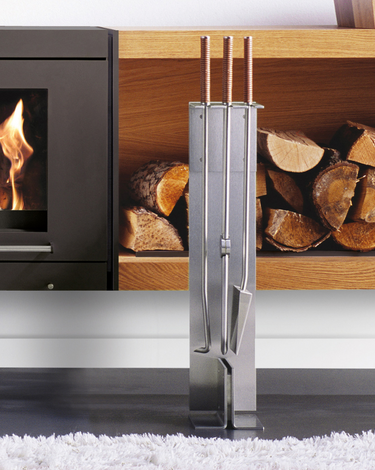
A German company named after a musical tempo, a German furniture designer who wanted fireplace tools without the frills, and an Italian architect who sends old railway track to a water-powered forge. This is the story of conmoto's fireside pieces and the three designers behind the ones we carry.
conmoto at a glance
- Founded in 1997 in Münster, Germany, by Johannes Wagner; its very first product was a stainless steel fireplace tool set
- The name comes from the musical direction "con moto," which means "with movement"
- Fireside designs by Peter Maly (Germany), Marco Ferreri (Italy) and Sebastian David Büscher (Germany)
- Since 2019 conmoto runs its own factory near Münster and builds to order rather than to stock
- Shop the collection: conmoto fireside tools at LoftModern
A company that began at the hearth
Most furniture brands arrive at the fireplace late, as an accessory line. conmoto started there. When Johannes Wagner founded the company in Münster in 1997, his first product was a set of stainless steel fireplace tools, and that set already carried the idea the company still works by: an everyday object can be both useful and beautiful, with nothing added for show.
The name is a musician's instruction. "Con moto" asks a player to perform with movement, and conmoto has kept moving since: from fireside tools to indoor and outdoor furniture, then to a projects studio for architects and hotels in 2008. The fireside pieces remain the root of the family tree, and they are the part of the range we carry.
Peter Maly: the set that started it all
The tools Wagner launched with were designed by Peter Maly, and conmoto still describes them as the beginning of the company. Maly is one of the quiet giants of German furniture design. In the 1960s he led the interior design team at the magazine Schöner Wohnen; in 1970 he went independent and opened his own studio. His furniture has since been produced by leading manufacturers and sold around the world, and it has earned him many national and international awards.
His signature is geometry. Maly works with elementary forms, the square, the circle, the straight line, and strips away everything else until what remains is clear, useful and built to last. Applied to the fireplace, that meant a slim square column of brushed stainless steel and three tools standing inside it: poker, tongs and shovel. conmoto says the design set out to free the fireplace from kitsch, and it does exactly that.

Leather where the hand meets the steel
The one warm material in the set is the most thoughtful detail. Each handle is wrapped in leather, so your hand stays off steel that can heat up near the fire, and the leather is ribbed all the way around so the tool does not slip when you lift a log. The steel itself is V2A stainless, chosen because it resists rust and needs very little care. The Peter Maly Fireside Tools with Floor Stand remain in conmoto's range today, and the matching Peter Maly Spark Guard Base carries the same thinking to the front of the hearth: a low steel foot made to hold a clear panel so the flames stay in view. Read more about the designer on our Peter Maly page.
Marco Ferreri: iron with a past life
The second voice in the collection is Italian. Marco Ferreri was born in Imperia in 1958, graduated in architecture from the Politecnico di Milano in 1981, and has run his own studio in Milan ever since. His work moves between industrial design, graphics, architecture and installations. His Less chair and the Libroletto, a book-bed he created with Bruno Munari, were both selected for Italy's Compasso d'Oro, and his designs are held by the Museum of Modern Art in New York. He has also taught at the Politecnico, the Brera Academy and the Free University of Bozen.
For conmoto, Ferreri drew A Ferro e Fuoco, Italian for "with iron and fire." The starting material is scrap iron from discarded railway tracks. It is taken to a hammer mill that conmoto says is 500 years old, where the iron is forged by hand with hammers driven by water power. The hammer leaves its marks on every piece, so no two are the same.

How a rail becomes a poker
Look closely at a Ferro e Fuoco piece and you can read how it was made. The ends of the tongs and poker are flattened into paddles under the hammer. Tubes are formed by rolling hot iron around on itself, leaving a visible seam. The feet of the firedogs are drawn out, bent and flattened, then left with the dark scale of the forge. Nothing is ground smooth to look machine-made, because the point is to see the hand and the hammer.

The family we carry covers the whole hearth: the three-piece Ferro e Fuoco Fire Irons, a three-legged Railroad-Steel Tool Tripod to stand them in, a Forged Wall Rail to hang them from instead, and two log holders, the Tall Firedogs sold as a pair and the single Low Firedog. More on the designer is on our Marco Ferreri page.

Sebastian David Büscher: architecture at small scale
The third designer works between buildings and objects. Sebastian David Büscher was born in Hamm in 1976 and studied interior design at the Hildesheim University of Applied Sciences. After working for several interior designers, he founded his own practice in 2002, as an architect with a strong pull toward product design. For him the two disciplines run into each other: good architecture leads naturally into interiors, and interiors into furniture and objects. His firm has won several design awards and architecture prizes, and his motto, as conmoto quotes it, is "as little as possible, as much as necessary."
That motto shows in both of his fireside sets. The Sino Fireside Tools rethink the classic stand as a circle: poker, tongs, broom and dustpan hang from one central post on a round base, so every tool is in reach from any side. conmoto made the tools light enough to handle with one hand, in A2 stainless steel. The Teras Fireside Set takes the opposite route, an L-shaped stainless stand with a clear glass panel at its center, which makes four working tools look almost weightless. Read more on our Sebastian David Büscher page.

Made to order near Münster
In 2019 conmoto took over its own factory near Münster, a decision the company presents as a commitment to regional production, quality and craft. It works just in time rather than from shelves of finished stock, building pieces when they are ordered. The short film below, from conmoto, goes inside that factory, from the machines to the finished panel.
Three designers, one idea
Put the three side by side and the differences are obvious: polished German geometry, raw Italian iron, an architect's glass and circle. What they share is restraint. Each set does the same four or five jobs at the fire, and each refuses to decorate them. That is why a conmoto piece can stand beside a minimalist built-in fireplace or a rough stone hearth and look like it was designed for that room.
Meet the collection
Every conmoto piece in this story is available to order directly from LoftModern:
- By Peter Maly: Fireside Tools with Floor Stand and the Spark Guard Base in Steel
- By Marco Ferreri: Ferro e Fuoco Fire Irons, Tool Tripod, Wall Rail, Tall Firedogs and Low Firedog
- By Sebastian David Büscher: Sino Circular Tool Stand and Teras Fireside Set with Glass Panel
See them all in our conmoto collection, or browse fireplaces for the hearth itself.
Keep reading
- How do I make my living room cozy for winter? A fireside corner, step by step
- The best hand-forged gifts, from Japanese and Korean forges
- More forge stories: Master Shin's Anvil, a Korean blacksmith and Toyama Hamono's shears from Sanjo
Frequently asked questions
Who founded conmoto?
Johannes Wagner founded conmoto in Münster, Germany, in 1997. The company's first product was a stainless steel fireplace tool set designed by Peter Maly.
Who designed the Ferro e Fuoco fireplace tools?
Italian architect and designer Marco Ferreri, who works from his studio in Milan. The pieces are hand-forged from reclaimed railway iron in a water-powered hammer mill that conmoto says is 500 years old.
Why does every Ferro e Fuoco piece look slightly different?
Each one is forged by hand, so the hammer marks, the rolled seams and the forge scale are unique to that piece. The variation is part of the design, not a flaw.
What is the idea behind Sebastian David Büscher's Sino and Teras sets?
Büscher is an architect who designs objects with the same clarity as buildings. Sino arranges four tools in a circle around one post so they can be reached from any side; Teras sets four tools in front of a clear glass panel to keep the stand visually light.
What does "conmoto" mean?
It comes from the musical term "con moto," meaning "with movement," which the company chose to reflect how it keeps developing its range.
Sources: conmoto, About Us; conmoto, designer profile Peter Maly; conmoto, designer profile Sebastian Büscher; conmoto, A Ferro e Fuoco; Stylepark, Marco Ferreri. Photos and film courtesy of conmoto.