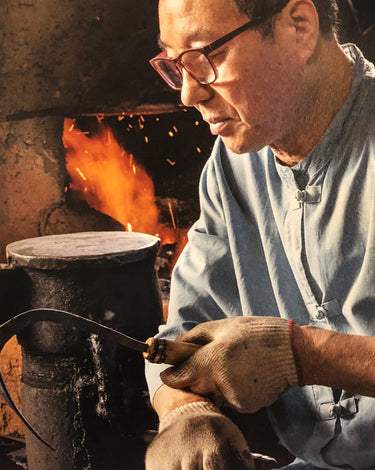
In a market town south of Seoul, a smith lights his forge before dawn, as the men before him did. This is the story of Master Shin In-young, the workshop his family has kept since 1845, and how a knife or a sickle leaves it.
Master Shin’s Anvil at a glance
- Blacksmith shop in Anseong, South Korea, founded in 1845 and described by the workshop as the oldest still working in Korea
- Led by Master Shin In-young, who began at 13 and became the forge’s master smith at 17
- Gyeonggi Province Intangible Cultural Heritage No. 60 (yajang, traditional blacksmith), designated in 2016
- Knives and garden tools forged by hand from repurposed railroad rail, with chestnut handles bound in an X
- Shop the collection: Master Shin’s Anvil at LoftModern
A town built on brass, stone and iron
Anseong sits on the old road network that once tied Seoul to the southern provinces, and its market drew traders, farmers and craftsmen for generations. The town became known for its brassware, stonework and ironwork, and for the number of blacksmiths who worked there. According to the workshop, the Shin blacksmith shop was established in Anseong in 1845. Its Korean name, Anseong Daejanggan, simply means “the Anseong smithy”.
Most of those smithies are gone. Korea moved from farming to industry in a single lifetime, and a sickle that once took a smith an hour by hand could be stamped out by the dozen in a factory. The Shin forge kept its fire burning anyway, and today it is described as the oldest working blacksmith shop in the country.
The boy who fell for a sword
Shin In-young did not inherit the hammer straight from his father. As a regional newspaper, Kyeonggi Ilbo, tells it, he was drawn in as a boy by a long sword kept by Kang Seok-bong, his uncle by marriage and the forge’s fourth master smith. He started working at the anvil at 13. By 17 he had become a yajang, a master blacksmith, and the fifth to lead the forge. GQ Korea describes him as the youngest yajang of his time.
More than fifty years on, he still begins early. Kyeonggi Ilbo’s 2023 portrait of him opens at three in the morning, with the forge glowing red in a dark field. Beside it stand tools he made for himself: tongs, a lamp, and a wooden anvil stand hollowed on the inside so nothing slides off. His hammer is wrapped in rubber to the thickness of his grip.
Asked how he has kept going, he points to an even, steady mind rather than talent or luck. “Doing something for a long time doesn’t make you good at it,” he told GQ Korea; you have to actually do it well.

A living cultural treasure
In 2016, Gyeonggi Province named him Intangible Cultural Heritage No. 60 for the craft of the yajang. The workshop says it was the first time the honor went to an individual. The number now appears in the stamp struck into his blades.
The recognition rests on rare knowledge. Traditional Korean smiths joined a hard, sharp steel to a softer, tougher iron so a blade could hold an edge without snapping. In the old method, called jeopsoe, the two metals were joined with the help of loess clay. Master Shin is described as the only smith still practicing it. When the Anseong Machum Museum marked its 20th anniversary in 2022, it gave him an exhibition of his own, titled “This Man Is a Blacksmith”, and singled out this joining technique.
Korea has also turned to him when its monuments needed iron. He forged iron plates for the restoration of Sungnyemun, Seoul’s great south gate, after the fire of 2008. When the stone pagoda of Mireuksa Temple in Iksan was restored, he made the stoneworking tools the masons used. Read more about his life on our Master Shin In-young designer page.
From railroad rail to blade
Every piece begins with old railroad track. Rail is carbon steel rich in manganese, made to take a beating from trains for decades. Heated in the coal fire, it can be drawn and shaped; quenched, it becomes hard and wear-resistant. Master Shin’s blades are water-quenched to a hardness of roughly 57 to 62 on the Rockwell scale, a balance between a keen edge and a blade that flexes rather than breaks.

Then comes the hammering. A kitchen knife is struck around a thousand times to bring the steel down to a thin, sharp edge. Unlike most Japanese and Western knives, his blades have no separate angled bevel ground along the edge. The taper is worked into the steel by hammer, which takes longer and is simply the way he prefers to make a knife. The marks of that work stay on the blade’s face.
His garden tools follow the same logic of fitting the job. Each hoe and sickle is shaped for a particular kind of soil and working depth, and they are made in left-handed and right-handed versions. The Anseong Machum Museum notes that the Korean hand hoe, the homi, takes a different shape from one region to another, and that people came from across the country to have one made the way their home soil needed. The forge’s range runs to about forty designs.
The X on the handle
Look where blade meets wood. Handles are cut from chestnut, dried slowly for years so they end up light, strong and resistant to rot. Between the steel and the wood sits an iron band called the dang-ghi, wrapped so the tang, the root of the blade inside the handle, cannot work loose.

GQ Korea explains that the dang-ghi was once how buyers judged a knife and the smith who made it, and that factories later replaced it with a pressed fitting. Master Shin kept the band but changed the method: he tightens the iron as if tying a ribbon, without scorching deep into the wood. The X mark is his other signature. In Korea it traditionally set apart the finest knives, and Kyeonggi Ilbo notes that at his forge it goes only on the best work, and that buyers abroad now recognize it.
The sixth generation
The workshop is now presented by his daughter, Shin Mi-rae, whom GQ Korea describes as its sixth-generation head. She has her own way of putting the craft: the angle of a blade and the feel of a grip are recorded too, she says, only in a different language from data. She also draws a line between precision and craftsmanship, which, in her words, are not the same thing. A well-made tool, the family says, explains itself the moment you hold it.
That handover is shaping what the forge makes next. Alongside farm tools and kitchen knives, GQ Korea reports new tableware such as butter, cheese and steak knives, while the oldest designs stay in production.

Meet the collection
Every Master Shin’s Anvil piece in this story is available to order directly from LoftModern:
- In the kitchen: Hand-Forged Heavy Chef's Knife, All-Purpose Kitchen Knife, Small Kitchen Knife and Straight-Edge Vegetable Knife
- For slicing: Slim Sashimi Knife and Non-Serrated Bread Knife
- Small work: Flat-Blade Paring Knife and Curved Paring Knife
- At the table: Hand-Forged Carving Knife & Fork Set
- In the garden: Garden Trowel, Garden Hand Fork, Three-Tine Hand Cultivator, Winged Garden Hoe, Wide-Blade Sickle and Slim Spring-Steel Sickle

See the full range in our Master Shin’s Anvil collection, or browse more kitchen and dining pieces we carry.
Keep reading
- What are the best hand-forged gifts for cooks and gardeners?
- Master Shin In-young: Korea’s living blacksmith tradition
- More maker stories: Oigen’s Japanese cast-iron heirlooms, Yama-Biko’s wild grapevine baskets and how APE Amsterdam designed the Humble lamp
Frequently asked questions
Who is Master Shin In-young?
Master Shin In-young is a blacksmith in Anseong, South Korea, and the fifth master smith of a forge founded in 1845. He began working at the anvil at 13, became a master at 17, and was designated Gyeonggi Province Intangible Cultural Heritage No. 60 in 2016.
Where are Master Shin’s Anvil knives made?
Every knife and garden tool is forged by hand at the family’s blacksmith shop in Anseong, a city south of Seoul long known for its brass, stone and iron crafts.
What steel does Master Shin use?
He forges from repurposed railroad rail, a manganese-rich carbon steel. The blades are water-quenched to a hardness of roughly 57 to 62 and hammered to a thin edge without a separate ground bevel.
What does the X on the handle mean?
The X-shaped binding, together with the iron band called the dang-ghi, is Master Shin’s signature. In Korea the X traditionally marked the finest knives, and at his forge it goes on the best work.
Sources: Kyeonggi Ilbo, “A day with Gyeonggi’s intangible heritage masters” (January 2023); GQ Korea, Korean craft masters feature (November 2026); Anseong Machum Museum, 20th-anniversary exhibition “This Man Is a Blacksmith: Shin In-young’s Anseong Daejanggan” (2022); Master Shin’s Anvil workshop materials and photography.