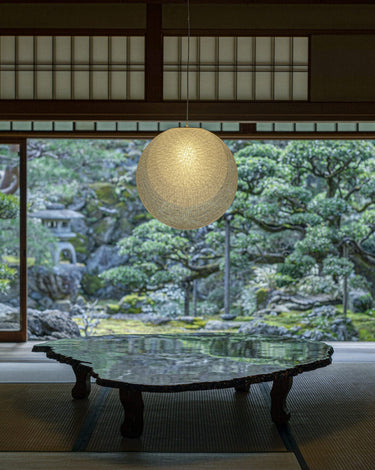
One is a Pritzker Prize–winning architect from Tokyo who spun light into a cocoon. The other was a Swedish lighting designer who sliced pine thin enough for light to pass through. Yamagiwa, a Tokyo lighting house founded in 1923, makes both of their lamps by hand in Japan. This is the story behind them.
Yamagiwa at a glance
- Founded in Tokyo’s Akihabara district in 1923; designing its own lighting since the late 1960s
- Has worked with more than 70 architects and designers from Japan and abroad, according to Yamagiwa
- Mayuhana by architect Toyo Ito: layered glass fiber shades, handmade one by one in Japan
- Jakobsson Lamp by Hans-Agne Jakobsson: a 1960s Swedish design in thin-sliced pine, revived by Yamagiwa in 1997
- Shop the collection: Yamagiwa lighting at LoftModern
From an Akihabara wholesaler to “The Art of Lighting”
Yamagiwa started out in 1923 as a wholesaler of electrical supplies in Akihabara, Tokyo’s electronics quarter. Lighting became its own department in 1954, and ten years later the company began importing Western lighting brands and lighting public and private projects: museums, offices, shops and hotels.
In the late 1960s Yamagiwa started designing fixtures of its own, and it set up in-house lighting design and engineering labs that, the company says, trained a generation of Japanese lighting designers. Since then it has collaborated with more than 70 architects and designers. Yamagiwa marked its 100th anniversary in 2023 and now works under a simple tagline, “The Art of Lighting”: lighting you feel, the way you feel art.
Toyo Ito, the architect who thinks in layers
Toyo Ito was born in 1941 and graduated in architecture from the University of Tokyo in 1965. His buildings, among them the Sendai Mediatheque, the Tama Art University Library and the National Taichung Theater in Taiwan, explore the relationship between architecture and nature, and between people and the spaces they share. He has received the Golden Lion at the Venice Biennale, the RIBA Royal Gold Medal and, in 2013, the Pritzker Architecture Prize. In 2026 Japan awarded him the Order of Culture.

Yamagiwa introduced Ito’s Mayuhana lamps in 2007. Mayu is Japanese for cocoon, and Yamagiwa describes the lamp as being born the way silk is spun from one: a fine thread wound into a soft, organic shell. The series won the Design for Asia Grand Award in 2009 and remains one of the lamps Yamagiwa is best known for.

Spun, not molded: how a Mayuhana is made
Each Mayuhana shade is made by hand by craftspeople in Japan, one at a time. Fine glass fiber is built up into a shell, and two or three of these shells are nested inside one another. The double-shade models, such as the Mayuhana 2 Sphere and Mayuhana 2 Oval, have two layers; the Mayuhana Mie (mie means threefold) has three.
Those layers are the whole idea. Switched off, the lamp reads as a sculpture of tangled white or black thread. Switched on, the inner shells catch and filter the light, and the room fills with a fine web of light and shadow. Yamagiwa compares the glow to a bonbori, the soft paper lantern of old Japan. Because glass fiber is so light, the shades are also easy to hang and hard to break, a quiet practical bonus.

Yamagiwa’s own film goes inside the workshops where its lamps are made: Mayuhana shades taking shape in the hands of the craftspeople who build them, and the pine bands of the Jakobsson Lamp being fitted by hand.

Hans-Agne Jakobsson and the lamp made of pine
The second designer in Yamagiwa’s house was working half a world away. In the 1960s, the Swedish lighting designer Hans-Agne Jakobsson created a lamp from dense-grained Nordic pine, the slow-growing European red pine also used for fine furniture. The wood is dried, sliced into thin bands and combined into tiers, so the lamp glows through the wood itself.

Yamagiwa says that when people switch one on for the first time, many describe the same thing: warm light coming through pine. The glow recalls a campfire, or the last hour of dusk.

A Swedish classic, revived in Japan
Production of the lamp eventually stopped in Sweden. In 1997 Yamagiwa brought it back, and it did so with the designer’s blessing: Jakobsson supervised the Japanese production himself, so that the revival would stay faithful to his original.
The making has not changed much since. Craftspeople in Japan slice the pine, adjust each band to the diameter it will sit at, and finish every shade by hand. Because it is real wood, no two lamps share the same grain or color, and the natural resin keeps ageing: over the years the pine deepens to a rich amber. Yamagiwa calls it a lamp that grows with the home.

Two designers, one idea of light
On paper, a Pritzker-winning architect’s glass fiber cocoon and a Swedish designer’s pine lantern have little in common. In the room they do the same thing. Neither lamp hides its light source behind an opaque shade; both let light pass through a material you can see, thread in one case and wood grain in the other, and both turn a lamp into an object worth looking at even when it is off. That shared idea, and the handwork it takes, is what ties Yamagiwa’s collection together.
Meet the collection
Every Yamagiwa lamp in this story is available to order directly from LoftModern:
- Mayuhana by Toyo Ito: Mie Triple-Shade Pendant, Mie Triple-Shade Floor Lamp, Mayuhana 2 Sphere Pendant, Mayuhana 2 Oval Pendant, Mayuhana 2 Mini Pendant and the Yugami Asymmetric Floor Lamp
- Jakobsson Lamp by Hans-Agne Jakobsson: Large Pine Pendant, Large Pine Table Lamp, Small Pine Table Lamp and the Pine Floor Lamp
See the full range in our Yamagiwa collection, or meet the designers on our Toyo Ito and Hans-Agne Jakobsson pages.
Keep reading
- What is Japandi lighting?
- Paper pendant lights: how to pick the size
- More maker stories: Asano’s Gifu lanterns and Shigeru Uchida’s Paper Moon and Le Klint’s hand-folded Danish lampshades
Frequently asked questions
Who designed the Mayuhana lamps for Yamagiwa?
Japanese architect Toyo Ito, winner of the 2013 Pritzker Architecture Prize. Yamagiwa introduced the series in 2007, and it won the Design for Asia Grand Award in 2009.
How is a Mayuhana shade made?
Japanese craftspeople make each shade by hand from fine glass fiber, building up two or three nested layers. The layers soften the light and, when lit, draw a fine web of light and shadow.
Why is the Jakobsson Lamp made in Japan?
Hans-Agne Jakobsson designed it in Sweden in the 1960s. After production there stopped, Yamagiwa revived it in 1997, making it in Japan under the designer's full supervision so it stays faithful to the original.
Does the pine in a Jakobsson Lamp change over time?
Yes. The natural resin in the pine slowly turns a deeper amber with age, and because it is real wood, grain and color vary from lamp to lamp.
Sources: Yamagiwa, corporate history and awards; Yamagiwa, Toyo Ito and the Mayuhana series; Yamagiwa, Jakobsson Lamp; The Pritzker Architecture Prize, 2013 laureate announcement. Photos and film courtesy of Yamagiwa. Portrait of Toyo Ito by FUJITSUKA Mitsumasa, courtesy of Yamagiwa; portrait of Hans-Agne Jakobsson courtesy of Yamagiwa.