A lantern workshop in Gifu that has been winding bamboo and pasting paper since 1917, and the designer of Tokyo boutiques and folding tea rooms who gave it five new shapes. This is the story behind Asano's Paper Moon lamps and how a Gifu lantern is still made by hand.
Asano and Paper Moon at a glance
- Asano Shoten (Asano Co., Ltd.) was founded in 1917 in the castle town of Gifu, Japan, and still makes traditional Gifu chochin
- Gifu lanterns are built from Mino washi and hair-thin bamboo strips; Japan designated them a national traditional craft in 1995
- Paper Moon is a family of five lantern lamps drawn for Asano in 1990 by designer Shigeru Uchida (1943 to 2016)
- Each shade is a continuous spiral of bamboo inside a wire armature, covered panel by panel in washi
- Asano also makes the Donguri, Tawara and Mari floor lanterns and the Hibit pendants
- Shop the collection: Asano and Paper Moon lamps at LoftModern
A lantern town on the Nagara River
Gifu grew up at the foot of Mount Kinka, where Oda Nobunaga once ruled from the castle above the Nagara River. Boats brought paper and bamboo down the river from the mountains, and the town turned them into umbrellas, fans and lanterns. According to Japan's association for traditional crafts, lantern making took hold in Gifu in the mid-1700s; in the Horeki era (1751 to 1763) a Gifu lantern maker named Juzo presented his work to the Tokugawa shogunate, and the name spread.
The lanterns went abroad early. Japanese government records note a silver prize at the 1904 St. Louis World's Fair, a gold at Liege in 1905 and another in Paris in 1937. In 1995 the national government designated the Gifu chochin a traditional craft of Japan, and Gifu Prefecture still leads the country in lantern shipments.
Asano: a hundred-odd years of chochin
Asano Shoten opened in 1917 in Honmachi, in the old castle district. Gifu Prefecture's product register describes the company plainly: since its founding it has mainly made the traditional craftwork of Gifu lanterns, from bon lanterns hung for the summer festival of the dead to lanterns for festivals and rituals. Today it is led by president Yusei Asano, and a team of around forty people works on everything from paper lanterns to lantern lamps.
What makes Asano interesting to a design shop is the second half of that description. While keeping traditional technique at the center, the company set out to propose new lantern forms for modern life, with interior lighting lines such as Paper Moon, FORM and Porcini. The Porcini family won a special jury award at Japan's Nippon Mono Ichi craft fair.

How a Gifu lantern is made
A traditional Gifu lantern passes through several specialists. Painters and stencil printers decorate the paper, woodworkers turn the rings and stands, and the harishi, the paper hangers, build the glowing body of the lantern, called the hibukuro or "fire bag." Asano's lamps are plain white, so the harishi's work is what you see.
1. The mold and the bamboo
The harishi assembles a wooden mold carved with spiral grooves. A strip of madake or hachiku bamboo, shaved to about 0.6 to 0.7 mm and as long as four meters, is wound into the grooves under even tension, despite knots and changes in thickness. On a lantern about 30 cm across, the strip is joined with thread twenty or more times; thinner bamboo and more stitches mark a finer lantern.
2. Pasting the washi
Fine threads are run along the bamboo to control the paper and protect it. Glue goes on between them, and the washi is laid on in sections; a classic lantern takes about eight sheets. Mino washi, made upriver from Gifu, is prized for this because it is thin yet strong and even, so the light comes through without blotches.
3. The razor and the mold
Excess paper is trimmed along the thread with a razor, leaving an overlap of about a millimeter. Any wider and the seam would show as a dark line when the lamp is lit. The lantern dries slowly on the mold, which is then taken apart and removed, and the creases are set with a spatula. By the craft association's count, even a skilled paper hanger finishes only five or six lanterns a day.
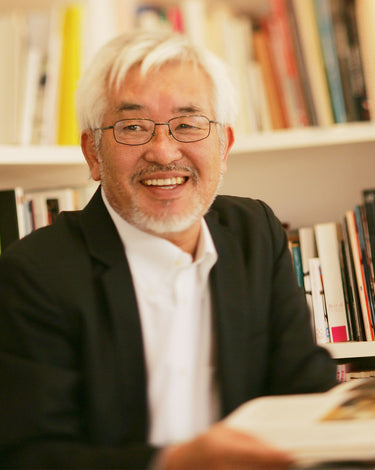
Shigeru Uchida: a designer of spaces
Shigeru Uchida was born in Yokohama in 1943 and graduated from the Kuwasawa Design School in 1966. He opened Uchida Design Studio in 1970 and, in 1981, founded Studio 80 with Toru Nishioka. He worked above all as an interior designer. His shops for Yohji Yamamoto, the interiors of Aldo Rossi's Hotel Il Palazzo in Fukuoka and the Kobe Fashion Museum made him one of the best-known names in Japanese design.
His furniture is just as spare. The September chair of 1977, a thin steel frame around an open seat, entered the Metropolitan Museum of Art in New York in 1988, and his work is also held by the San Francisco Museum of Modern Art and the Denver Art Museum. In the 1990s he took three folding tea rooms, Ji-an, So-an and Gyo-an, on tour to European museums to show how Japanese space works. Later he led his old school, Kuwasawa, as its ninth director. He died in 2016.

Paper Moon: five shapes from one craft
In 1990 Uchida drew a family of five lantern lamps for Asano. He did not decorate the lantern or reinvent it. He kept its whole structure, a wire armature that opens out a single continuous spiral of bamboo filament under high-grade washi, and changed only the silhouette. Japanese shops still sell them by their nicknames:
- Paper Moon 1, the egg, 24.1 cm (9.5 in) tall
- Paper Moon 2, the gourd, with a soft waist
- Paper Moon 3, the bamboo shoot, a narrow spire 35.6 cm (14 in) tall
- Paper Moon 4, a low, wide dome like a moon half over the horizon
- Paper Moon 5, the full round moon, 30.5 cm (12 in) across
The shapes are meant to be seen together, at different heights, the way Uchida composed objects in a room. Each lamp folds flat into a gift box and opens out on its steel base plate in a moment, which is how a lantern has always traveled. Because every shade is pasted by hand, the paper shows small differences from one lamp to the next.

Asano's own lanterns: Chochin lamps and Hibit
Next to Uchida's family, Asano makes lamps under its own name. The three Chochin floor lanterns stand about 50 cm high on slim steel legs, each shade in Mino washi, and each named after a familiar shape: Donguri, the acorn; Tawara, the rice bale; and Mari, the ball. For the ceiling, the Hibit pendant uses the same bamboo-and-wire structure as Paper Moon in four sizes, Hibit 45, Hibit 60, Hibit 75 and Hibit 90, with a white or black cord.


Meet the collection
Every Asano lamp in this story is available to order directly from LoftModern:
- Paper Moon by Shigeru Uchida: Paper Moon 1 Washi Paper Lamp, Paper Moon 2 Washi Paper Lamp, Paper Moon 3 Washi Paper Lamp, Paper Moon 4 Washi Paper Lamp and Paper Moon 5 Washi Paper Lamp
- Chochin floor lanterns: Donguri Mino Washi Lantern Lamp, Tawara Mino Washi Lantern Lamp and Mari Mino Washi Lantern Lamp
- Hibit pendants: Hibit 45 Washi Pendant Lamp, Hibit 60 Washi Pendant Lamp, Hibit 75 Washi Pendant Lamp and Hibit 90 Washi Pendant Lamp
See them together in our Asano and Paper Moon collection, read more about Shigeru Uchida, or browse all table lamps, floor lamps and pendant lights.
Keep reading
- What is Japandi lighting, and how do you get the look?
- The art of layered lighting, room by room
- More maker stories: five generations at Toyama Hamono's forge in Sanjo and Master Shin In-young's forge in Anseong
- How APE Amsterdam designed the Humble cordless lamp
Frequently asked questions
Who designed the Paper Moon lamps?
The Japanese interior and furniture designer Shigeru Uchida (1943 to 2016) drew the five Paper Moon shapes for Asano in 1990. Asano makes them by hand in Gifu.
Who is Asano?
Asano Shoten (Asano Co., Ltd.) is a lantern maker founded in 1917 in the old castle town of Gifu, Japan. It still makes traditional Gifu chochin for Obon and festivals, alongside lantern lamps such as Paper Moon.
How is a Paper Moon shade made?
A thin, continuous strip of bamboo is wound in a spiral and held open by a wire armature, then sheets of washi paper are pasted on one panel at a time until the whole surface is covered. It is the same idea a Gifu lantern maker uses on a wooden mold.
What is a Gifu chochin?
A paper lantern from Gifu Prefecture made from fine Mino washi and thin strips of bamboo. Lantern making there goes back to the mid-1700s, and Japan named Gifu chochin a national traditional craft in 1995.
Are the Chochin lamps designed by Shigeru Uchida too?
No. Uchida is credited with the five Paper Moon shapes. The Donguri, Tawara and Mari lamps and the Hibit pendants are Asano's own designs.
Sources: Gifu Prefecture product register, Asano Co., Ltd.; JETRO Gifu company profile; Association for the Promotion of Traditional Craft Industries, Gifu Chochin; Highlighting Japan, The Traditional Light of Gifu Paper Lanterns (2022); The Metropolitan Museum of Art, September armchair; Uchida Design Institute. Portrait of Shigeru Uchida courtesy of Lemnos. Film: TEWAZA, Aoyama Square.