A wooden fox carved for a sculptor's own children in 1944. Dada puppets made for a Zurich stage in 1918. Bauhaus Christmas ornaments found in a Cologne architect's estate. Today these designs are being made again, by hand, under license from the families, foundations and museums that look after them.
At a glance
- Licensed re-editions of modernist classics and forgotten pieces, made with the estates, foundations and museums that hold the originals
- Designers: Antonio Vitali, Sophie Taeuber-Arp, Man Ray, Isamu Noguchi, Antonia Campi, Tibor Kalman and Cy Endfield
- Most wooden pieces are made by hand in Germany's Black Forest; the Vitali animals in Italy and Germany
- Shop the collection: modernist re-editions at LoftModern
Re-editions, not copies
Every piece in this story was designed between 1918 and 1991 by an artist or designer who changed how we look at everyday things. Some, like Man Ray's chess set, are famous. Others, like a box of Bauhaus Christmas ornaments, were nearly forgotten. What they share is how they come back: under license from the people who look after the originals, the Museum für Gestaltung Zürich, the Fondation Arp, the Man Ray Trust and the Noguchi Museum among them, and made by hand by specialist workshops rather than copied.
That is the difference between a re-edition and a reproduction. The proportions, materials and finishes follow the originals, and the families and institutions behind them sign off on the result.
Antonio Vitali: toys a child's hand understands
Antonio Vitali (1909–2008) trained as a sculptor in Zurich and Paris. He became a father at 23 and was widowed shortly after his second child was born. With money always tight, he made the family's furniture himself and carved simple wooden animals for his children. Watching them play, he noticed that they did not need realistic toys. A few smooth, rounded forms were enough for them to see a fox, a duck or a cat.

"Small, softly shaped objects which fit into the little child's hand are perceived as joyful and friendly and are repeatedly touched," he said. He went on to run workshops in Zurich, in Sornico in Switzerland's Valle Maggia, and in New York, and worked for decades with toy companies in the United States, Switzerland, Germany and Japan.
The licensed re-edition began in 2022, made possible with the Museum für Gestaltung Zürich, the Japanese toy company NikiTiki and the Zurich painter Resly Reis, Vitali's life companion. The animals are made in solid walnut, maple and cherry: the fox from 1944, the pair of rocking ducks from 1946, the snail from 1949, the goose from 1960, and the cat.

Sophie Taeuber-Arp and the Dada marionettes
Sophie Taeuber-Arp (1889–1943), born in Davos, was a painter, dancer, textile designer and one of the central figures of Zurich Dada. In 1918 she was asked to create the marionettes for a Dada version of King Stag, a tragicomedy by Carlo Gozzi, staged for the Swiss Werkbund exhibition in Zurich. She made 17 figures from turned, painted wood, with geometric bodies that moved in ways no conventional puppet did. The originals belong to the Museum für Gestaltung Zürich and are counted among the most important works of the avant-garde.

The museum has since helped re-edit them as posable wooden figures, without strings, made in the Black Forest from German wood in a limited edition of 100 each.

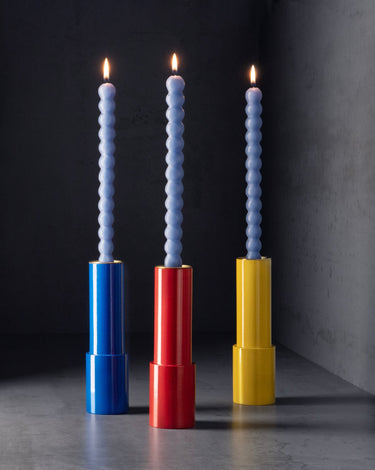
Eleven years later, Taeuber-Arp designed a set of plain wooden candlesticks for the house she and Hans Arp built in Meudon-Clamart, outside Paris. Cylinders and right angles, painted red, yellow, blue and white, they matched the couple's own furniture. The re-edition was made with the Fondation Arp and the Paris designer Gérard Lo Monaco: the wood is turned and painted in the Black Forest, and the brass inserts are made in Switzerland.
Bauhaus ornaments from an architect's attic
Among the quieter rediscoveries is a set of 12 turned-wood Christmas ornaments from 1929 and 1930, attributed to the Bauhaus architect Johannes Gabriel. The originals turned up in the estate of a Cologne architect who had bought many objects directly from the Bauhaus. Their stacked cones, discs and spheres recall Oskar Schlemmer's costumes for the Triadic Ballet. For the Bauhaus centenary in 2019 the set was re-edited, made and painted largely by hand in the Black Forest.
Antonia Campi and Tibor Kalman
Not every re-edition is wood. Antonia Campi, born in 1921 in Sondrio, worked across ceramics, metal, glass and jewelry and received Italy's lifetime Compasso d'Oro in 2011. Her 1958 neto scissors have an offset, professional-style grip, and her 1960 Italicus poultry shears are in the collection of the Museum of Modern Art. Tibor Kalman, the New York designer behind the studio M&Co., created his Global Alphabet Blocks with Scott Stowell in 1991, putting five writing systems side by side on one set of toy blocks.
Chess by artists
Chess drew in many modern artists. Man Ray's 1920 set turns the pieces into cubes, cones, pyramids and spheres; the re-edition follows the original in the Metropolitan Museum of Art, in solid beech made by hand in Germany, with a board inlaid square by square by a third-generation family maker. Isamu Noguchi's 1944 set, made for the Imagery of Chess exhibition at Julien Levy Gallery in New York, slots thin sheets of then-new Plexiglas together into glowing pieces. The 1972 travel set by Cy Endfield, a friend of Man Ray's, became the official souvenir of the Fischer–Spassky match.

We look at these sets one by one in our guide to designer chess sets as gifts.
Made by hand, made to be used
What links a fox, a puppet, a pair of scissors and a chess set is the way they are made: by hand, by specialist workshops, under license from the people who look after the originals. The Black Forest turners, the family that inlays the Man Ray boards, and the Swiss social workshop tät-tat that builds the steel board for the Endfield travel set all keep small-scale craft alive. Here is a closer look at the Vitali animals and the Taeuber-Arp figures:

Meet the collection
Every piece in this story can be ordered directly from LoftModern:
- Antonio Vitali animals: fox, cat, snail, goose and pair of ducks
- Sophie Taeuber-Arp: 1918 Dada marionettes and 1929 wooden candlestick
- Bauhaus-era wooden Christmas ornaments, set of 12
- Antonia Campi: neto offset-handle scissors and Italicus poultry shears
- Tibor Kalman Global Alphabet Blocks
- Chess: Man Ray pieces and board, Man Ray pieces, Man Ray board, Noguchi 1944 chess set and Cy Endfield travel chess set
See them all in our collection of modernist re-editions.
Keep reading
- Designer chess sets as holiday gifts
- Another Zurich story: Max Bill and Wohnbedarf
- More wooden icons: how Jakob Burgsø carves Boyhood's oak figures
More Man Ray: the Kuen surface jewelry and its story.
More heritage makers: Riess, Gudme Leth, Lorenz, Sirch, EGOUNDESIGN and Karst.
Another Italian design story: Castiglioni's last pencil, CENTO3.
Frequently asked questions
Who designed these pieces?
Antonio Vitali, Sophie Taeuber-Arp, Man Ray, Isamu Noguchi, Antonia Campi, Tibor Kalman and Cy Endfield, between 1918 and 1991.
Are these pieces reproductions?
They are licensed re-editions, made in collaboration with the designers' estates or institutions such as the Museum für Gestaltung Zürich, the Fondation Arp, the Man Ray Trust and the Noguchi Museum.
Who was Antonio Vitali?
A Swiss sculptor and toy designer (1909–2008) who carved smooth, rounded wooden animals, first for his own children, and later ran workshops in Zurich, Sornico and New York.
What are the Sophie Taeuber-Arp marionettes?
Re-editions of the 17 Dada marionettes she made in 1918 for the play King Stag. The originals are in the Museum für Gestaltung Zürich; the re-editions are posable wooden figures without strings, limited to 100 of each.
Where are the re-editions made?
Most wooden pieces are made by hand in Germany's Black Forest; the Vitali animals are crafted in Italy and Germany, and the brass parts of the Taeuber-Arp candlesticks in Switzerland.
Sources: Museum für Gestaltung Zürich, Antonio Vitali, Fuchs; Museum für Gestaltung Zürich, König Hirsch; MoMA, Sophie Taeuber-Arp: Living Abstraction; maker information for the licensed re-editions. Photos courtesy of the licensed producer.