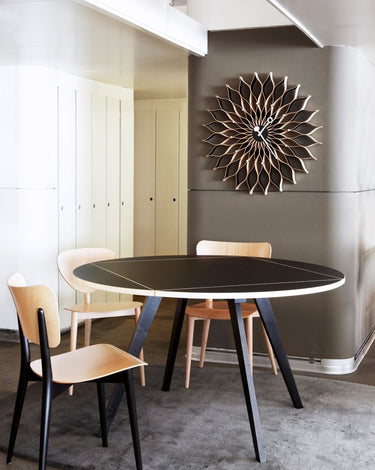
A Bauhaus student turned painter, sculptor, architect and graphic designer, a small Zurich furniture shop founded to sell good modern things, and a table that turns from a square into a circle in seconds. This is the story of Max Bill's furniture for Wohnbedarf, and how it is made again today.
Max Bill and Wohnbedarf at a glance
- Wohnbedarf was founded in Zurich in 1931 by architectural historian Sigfried Giedion, architect Werner Max Moser and businessman Rudolf Graber
- Max Bill (1908–1994) designed the company's logo and, for many years, its graphics
- His wooden furniture for Wohnbedarf dates from 1949 to 1951: the Square-Round Table, the Three Circles tables and the Cross-Frame Chair
- Since 2011 the pieces have been reissued from Bill's archive, with exclusive rights agreed with his son Jakob Bill
- Shop the collection: Wohnbedarf Max Bill furniture at LoftModern
A shop for good modern things
In 1931 three men in Zurich opened a furniture business with an unusual aim. Sigfried Giedion, the architectural historian, Werner Max Moser, the architect, and Rudolf Graber, the businessman, wanted ordinary household objects to be designed as carefully as modern buildings. They called it Wohnbedarf, which simply means "home needs," and gathered a circle of designers around it.
One of that circle was a young graphic designer named Max Bill. He drew the Wohnbedarf logo and handled the company's graphic design for many years, including posters from as early as 1932. Bill later described Wohnbedarf as the place for good contemporary furniture, and the company quickly earned that reputation.
From the Bauhaus to Zurich
Max Bill was born in Winterthur, Switzerland, in 1908. After finishing at the Zurich School of Applied Arts, he went to the Bauhaus in Dessau in 1928, where Paul Klee and Wassily Kandinsky were among his teachers. Back in Zurich he worked as a painter, sculptor, graphic designer, writer and architect, often all at once.

In 1950 he co-founded the Ulm School of Design in Germany, designed its buildings and served as its rector until 1956. Clocks, watches, posters, sculptures, paintings and houses all came out of the same conviction: a thing should be beautiful because of how well it works, and as part of how it works. He died in Berlin in 1994, aged 85, one of the most important Swiss artists of his time.
Die gute Form: good design as a public cause
For Bill, industrial design had special weight in the years after the war. Europe was rebuilding, and he saw well-made everyday objects as a way to improve the world people lived in. In 1949 he conceived the exhibition Die gute Form (Good Form) for the Swiss Werkbund, which put exemplary industrial products, most of them by anonymous factory designers, in front of the public. The phrase became a Swiss award for good design, and his own Three-Legged Chair for Wohnbedarf received it.
His furniture follows the same rules as his art. The wb form collection describes it as defined by clarity, simplicity and mathematical logic: function, durability and an economical use of materials, joined to formal and aesthetic ambition.
The Square-Round Table: concrete art you can eat at
Bill designed the Square-Round Table, the Quadratrundtisch, in 1949 for Wohnbedarf, and it is counted among his most important designs. Closed, it is a square table. Raise the four hinged leaves at its edges and they are supported by the frame, turning the top into a full circle. The maker's own film calls it "square to round in four seconds."

The lines where the leaves meet divide the black top into a rhythmic pattern, the same kind of geometry Bill explored in his concrete paintings. It is the clearest example of what he meant by concrete art in product design. Today's table has a solid maple frame, natural or black lacquered, a black linoleum top and a maple edge. It measures about 35 inches square closed and 50 inches across open, at 29 inches high.
Three circles, one strict outline
Free-form tables were everywhere in the early 1950s. The idea of the table en forme went back to Charlotte Perriand in the 1930s, and by the 1950s kidney shapes filled the design magazines. Bill's answer, designed around 1949 and 1950, was the Dreirundtisch, or Three Circles table. Its outline looks organic but is built from exactly three circles, and it stands on three legs.

He drew it in two heights, a dining table and a low coffee table, and it marks a high point in his campaign for design reform. Both versions are made with solid maple legs and a linoleum top, about 43 inches across.
The Cross-Frame Chair and the floating seat
Most chairs hold their seat with a rail running all the way around under it. For the Kreuzzargenstuhl, designed in 1951 and produced from 1952, Bill replaced that rail with two crossing rails that meet under the center of the seat. The seat is carried in the middle, which gives the chair its stability, and from the side it seems to float above the frame. The Museum für Gestaltung Zürich keeps the chair in its design collection.

The chair has a solid beech frame with a molded plywood seat and back. It comes black lacquered, in natural beech, or in the two-tone version with a black frame and a natural seat and back, which shows off the floating effect best. It is light in weight and in look, so it fits into almost any room.
Made again from the archive
Wohnbedarf was the original producer of Bill's furniture. In 2011, the company's 80th year, it brought the pieces back. Jakob Bill, Max Bill's son, who looks after his father's estate, opened the archives, agreed to exclusive production and distribution rights, and worked with the company on the new editions. The firm, known today as wb form, also reissued the Ulm Stool Bill designed with Hans Gugelot in 1954 for the Ulm School.
The tables are made in Germany. wb form says its collections are produced to the highest quality standards, many of them in Switzerland, and that it keeps its sales deliberately selective. Each piece is made to order.
Why it still looks new
Each of these pieces solves one geometric problem and then stops. A square that becomes a circle. Three circles that make one outline. Two crossed rails that let a seat float. Nothing is added for decoration, which is why furniture drawn between 1949 and 1951 still sits comfortably in a contemporary home, and why Bill's idea of good form still holds.
Meet the collection
Every Max Bill piece in this story can be ordered directly from LoftModern, made to order for you:
- Max Bill Square-Round Table, square to circle in maple and black linoleum
- Max Bill Three Circles Dining Table
- Max Bill Three Circles Low Coffee Table
- Max Bill Cross-Frame Chair
See them all together in our Wohnbedarf collection.
Keep reading
- Which side and coffee tables suit a small living room?
- Another Bauhaus story: Curt Fischer, the Bauhaus and how Midgard lamps are made
- More maker stories: Humble's cordless lamps from Amsterdam
Frequently asked questions
Who designed the Square-Round Table?
Swiss artist, architect and designer Max Bill designed the Square-Round Table (Quadratrundtisch) in 1949 for Wohnbedarf in Zurich.
How does the Square-Round Table change shape?
It is a square table with four hinged leaves at its edges. When the leaves are raised, the frame supports them and the top becomes a circle, about 35 inches square closed and 50 inches across open.
What is Wohnbedarf?
A Zurich furniture company founded in 1931 by Sigfried Giedion, Werner Max Moser and Rudolf Graber to sell well-designed modern furniture. Max Bill designed its logo and its graphics for many years, and his furniture for the company is reissued today by wb form.
Are these original Max Bill designs?
Yes. They are new editions made since 2011 from Bill's archive, under an exclusive agreement with his son Jakob Bill, who manages the estate.
What is the Cross-Frame Chair made of?
A solid beech frame with a molded plywood seat and back, in black lacquer, natural beech, or a black frame with a natural seat and back. Its two crossed rails support the seat from the center.
Sources: wb form, Max Bill; wb form, Square-Round Table; wb form, Three-Round Table; Stylepark, "Triumph of good design" (2011); Museum für Gestaltung Zürich, Kreuzzargenstuhl. Photos and film courtesy of wb form.