One began as a plaster model in a Paris maths institute that a Surrealist could not stop photographing. The other hung above a hotel bar in Tokyo, slowly turning. Two small design classics, a silver Kuen surface after Man Ray and Riki Watanabe's copper Chambre mobile, and the stories of how they came to be.
At a glance
- Man Ray photographed mathematical models at the Institut Henri Poincaré in Paris in the mid-1930s
- The Kuen surface, described by mathematician Theodor Kuen in 1884, is cast here in 925 sterling silver
- Riki Watanabe (1911–2013) was one of the founders of modern Japanese design
- His Chambre mobile, brushed copper and oiled teak, first hung in a Tokyo hotel bar
- Shop the collection: Man Ray and Riki Watanabe at LoftModern
Man Ray in the maths department
In the mid-1930s the art journal Cahiers d'Art, edited by Christian Zervos, sent Man Ray to the Institut Henri Poincaré in Paris. In its cabinets sat dusty teaching models made in the late 1800s and early 1900s: plaster, wood, papier-mâché and string forms that turned algebraic equations into objects students could hold. Max Ernst had seen them first and urged his friend to look. Man Ray was less interested in the equations than in the shapes, which under his lights looked strangely human.
The photographs stayed with him. When he fled France during the Nazi occupation, he took them to Hollywood, and in 1948 began painting them as a series he called the Shakespearean Equations, giving each canvas the title of a play. He considered the series one of the high points of his work. In 2015 The Phillips Collection in Washington showed the original models, the photographs and the paintings side by side for the first time.
The Kuen surface

Among the models was the Kuen surface, first described by the German mathematician Theodor Kuen in 1884. It has constant negative curvature, which means every point on it curves like a saddle, and from one side it can look like a small figure holding up a disc. In silver it becomes something you can wear: soft, almost figurative, and still pure geometry.
The pieces we carry are made in the United States in 925 sterling silver, after Man Ray, as cufflinks, earrings and a pendant necklace.

Riki Watanabe and a hotel bar
渡辺 力
Riki Watanabe · Tokyo · 1911–2013
Riki Watanabe was born in Tokyo in 1911. In 1936 he joined the Gunma Prefecture Industrial Arts Center, where the German architect Bruno Taut was working, and in 1949 he opened his own design office. His low-cost rope Himo chair of 1952 made his name, and over a long career he designed furniture, interiors and the clocks that still carry his name. He was a founding member of the Japan Industrial Designers' Association and is remembered as one of the pioneers of postwar Japanese design.
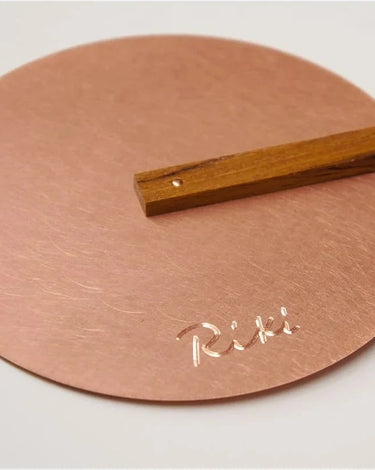
With his studio, Q Designers, Watanabe designed showrooms and hotel lounges. For the main bar of the Shinbashi Dai-ichi Hotel in Tokyo, called Chambre, he made a mobile in copper, the material that fascinated him most. Discs of brushed copper balance on slim arms of oiled teak and turn slowly on a fine cord, catching the light. In 2017 the mobile was reproduced for homes, in three- and four-piece versions.

Meet the collection
- Kuen Surface Silver Pendant Necklace: the statement piece
- Kuen Surface Silver Earrings: for everyday
- Kuen Surface Silver Cufflinks: for suits and black tie
- Chambre Copper and Teak Mobile by Riki Watanabe: from a Tokyo hotel bar
See them all in our Man Ray and Riki Watanabe collection.
Keep reading
- More Man Ray: Vitali, Taeuber-Arp, Man Ray and the modernist re-editions
- Gift ideas: designer chess sets as holiday gifts
Frequently asked questions
What is the Kuen surface?
A mathematical surface with constant negative curvature, described by Theodor Kuen in 1884. Man Ray photographed a model of it in Paris in the 1930s.
What are the Kuen surface jewelry pieces made of?
925 sterling silver, made in the United States.
Who was Riki Watanabe?
A Tokyo-born designer (1911–2013) and one of the pioneers of postwar Japanese design, known for furniture, interiors and clocks.
Where did the Chambre mobile come from?
Watanabe's studio made it for Chambre, the main bar of the Shinbashi Dai-ichi Hotel in Tokyo. It was reproduced for homes in 2017.
What is the Chambre mobile made of?
Brushed solid copper discs and oiled teak arms, hung on a thin cord.
Sources: The Phillips Collection, Man Ray–Human Equations; Wikipedia, Kuen surface; BEAMS fennica, Chambre mobile; Maison&Objet, Riki series; Side Gallery, Riki Watanabe.