小松 誠
Makoto Komatsu · for Ceramic Japan, Seto
A paper bag that will never tear. A teapot that looks back at you like a little bird. Makoto Komatsu has spent five decades making porcelain play tricks on the eye, and since the 1970s his ideas have been made in Seto, one of Japan's oldest pottery towns, by Ceramic Japan. This is how they are made.
At a glance
- Designer: Makoto Komatsu, born in Tokyo in 1943
- Maker: Ceramic Japan, founded in 1973 in Seto, Aichi Prefecture
- Crinkle series, designed in the mid-1970s, is in the collections of MoMA and the V&A
- Slip-cast in plaster molds and finished by hand
- Shop the collection: Ceramic Japan at LoftModern
Seto, the town that named pottery
Seto, east of Nagoya, has fired ceramics for around a thousand years. Its kilns were so important that the Japanese word setomono, things from Seto, is still used to mean ceramics in general. Ceramic Japan was founded there in 1973 with a simple idea: put Seto's skills to work on the ideas of contemporary designers, so that good design could reach many homes.

A designer who crumples porcelain
Makoto Komatsu, 小松誠, trained as a ceramic designer and later taught at Musashino Art University in Tokyo. In the mid-1970s he made a vase that looked exactly like a crumpled paper shopping bag. It was white porcelain, rigid and glazed, but every crease seemed soft. The Crinkle series grew from there into vases, cups, plates and chopstick rests, and The Museum of Modern Art in New York added several pieces to its permanent collection, made by Ceramic Japan. The V&A in London and Japan's National Crafts Museum hold his work too.
The idea is the same one that runs through all his pieces: take something ordinary and throwaway, and make it permanent, so that you look twice.

Made in plaster molds
Most Ceramic Japan pieces are slip-cast. Liquid clay is poured into a plaster mold, the plaster draws water from it, and a firm wall of clay forms against the inside. The extra slip is poured out, the piece is left to set, and the mold is opened. For a Crinkle vase, the mold holds every wrinkle of the bag, so the casting comes out creased just as Komatsu intended.

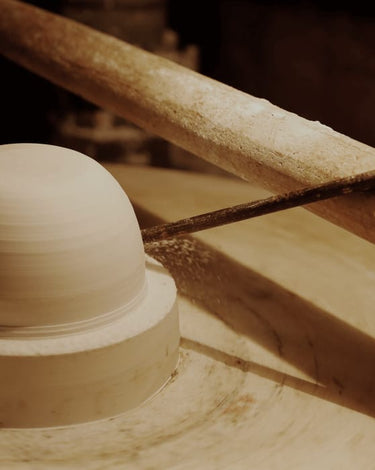
Each piece is then cleaned and smoothed by hand with a damp sponge, dried, glazed and fired. Seams are wiped away, edges are softened, and the glaze is checked before the kiln.

The animal teapots
Komatsu's humor shows most in his animal pots. The Tori is a round little bird with a beak for a spout. The Yagi is a goat, its horns curling at the shoulder. Both have a pale glaze brushed over warm clay, so the kiln's heat leaves soft flashes of color. Each has a sprung bamboo handle that lifts away for washing, and a stainless steel strainer inside for loose-leaf tea.

Meet the collection
- Crinkle Paper Bag Vase, White: the MoMA classic
- Tori Bird Teapot: a little bird that pours
- Yagi Goat Teapot: with curling horns
See them all in our Ceramic Japan collection, or explore more Japanese handmade craft.
Keep reading
- Another Japanese craft town: KUON brass bells from Takaoka
- For the kitchen: Oigen cast-iron ironware
More Japanese craft: the Umpei paper-wrapped calligraphy brushes of Hankeido.
More Japanese craft: five workshops for the table and home.
Frequently asked questions
Who designed the Crinkle paper bag vase?
Japanese ceramic designer Makoto Komatsu, born in 1943. The Crinkle series dates from the mid-1970s.
Is the Crinkle vase in a museum?
Yes. Crinkle pieces made by Ceramic Japan are in the permanent collection of The Museum of Modern Art in New York, and the V&A in London also holds Crinkle vases.
Where is Ceramic Japan?
In Seto, Aichi Prefecture, a pottery town so old that setomono became a Japanese word for ceramics. The company was founded there in 1973.
How are the pieces made?
They are slip-cast in plaster molds, then cleaned and smoothed by hand, glazed and fired.
Do the Tori and Yagi teapots have a strainer?
Yes, both come with a stainless steel strainer for loose-leaf tea.
Sources: Ceramic Japan; MoMA, Crinkle Super Bag Vase; V&A, Crinkle Series vase; National Crafts Museum, Makoto Komatsu. Workshop photos and film courtesy of Ceramic Japan.