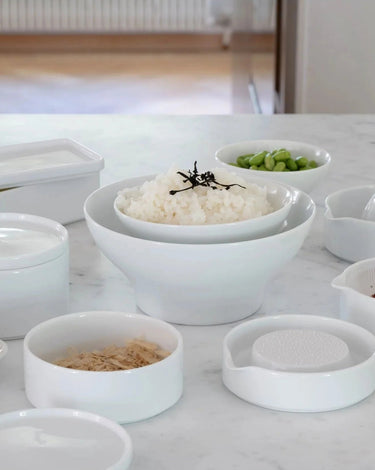
Five small Japanese makers, five objects for the table and the home: a lunch box carved from cypress, a cutting board that sits in porcelain, a sake set from Kyoto, enamel bowls made by hand and a hemp curtain dyed through paper stencils. Each comes from a workshop that has spent decades, or centuries, on one thing.
In this story
- Tsunoda Seibei, Kainan, Wakayama, since 1830: Kishu hinoki bento box
- Kihara, Arita porcelain: Sitaku hinoki board and porcelain tray
- Kumagai, Kyoto, since 1935: Nanban sake set
- Tsukiusagi-jirushi, enamelware made by hand since 1926: nesting bowls
- Yumi Ishikita for Noboriya, Hiroshima: katazome hemp noren
A lunch box from a lacquer house
角田清兵衛商店
Tsunoda Seibei · Kainan, Wakayama
Tsunoda Seibei opened in 1830 in Kainan, on the Wakayama coast, as a lacquerware business, and seven generations later it is still run by the family. Its bento boxes are cut from Kishu hinoki, the fragrant cypress of the Kii Peninsula. The box is hollowed from solid wood and pared down to walls about 5 millimeters thin, so finely that you can feel the air slip out as the lid settles. There are no joints or corners to trap food, and a protective coating means it can go in the dishwasher.

Porcelain from Arita
キハラ
Kihara · Arita
Potters in Arita, on the island of Kyushu, have worked its white kaolin clay into porcelain for more than four hundred years. Kihara's Sitaku line takes its name from shitaku, the preparation before cooking: small tools for grating ginger, squeezing lemons, grinding sesame and cutting. The cutting board is a single piece of light, fragrant hinoki that sits in a square porcelain tray. The tray catches every drop, then doubles as a serving plate.
Kyoto earthenware for two
熊谷
Kumagai · Kyoto
Kumagai was founded in 1935 and makes Kiyomizu-yaki, the pottery of Kyoto. Kyoto's kilns flourished when the city was the capital and the tea ceremony created demand for fine wares, drawing potters from across Japan. The Nanban set, a low lipped pourer and two cups in a dark, earthy clay, takes its name from a rustic, unglazed look prized by tea masters.

Enamel made by hand
月兎印
Tsukiusagi-jirushi · Moon Rabbit mark
Tsukiusagi-jirushi, the Moon Rabbit mark, began in 1926 and is run by Fujii, a trading house founded in 1923. Its enamelware is made by craftspeople at Noda Horo, one of Japan's best-known enamel makers, piece by piece. Enamel is glass fused onto steel at high temperature, so the bowls resist stains and odors, can go on a flame, and last for years. The navy-rimmed nesting set stacks five sizes into one.

A curtain dyed through stencils
型染 暖簾
Katazome noren · Yumi Ishikita, Hiroshima
Noren are the split fabric curtains hung in Japanese doorways and shop fronts. Hiroshima designer Yumi Ishikita makes hers in katazome: a pattern is cut into a paper stencil, a paste of rice is spread through it onto the cloth to resist the dye, and the fabric is then dyed and washed. She works on natural hemp with natural dyes, so the colors soften the light that passes through.

Shop the pieces
- Kishu Hinoki Cypress Bento Box S-4 by Tsunoda Seibei
- Sitaku Hinoki Board & Porcelain Tray by Kihara
- Nanban Sake Set for Two by Kumagai
- Navy Rim Enamel Nesting Bowls by Tsukiusagi-jirushi
- Katazome Hemp Noren Curtain by Yumi Ishikita
Explore more Japanese handmade craft.
Keep reading
- More Japanese craft: Makoto Komatsu and the potters of Seto
- For the kitchen: Oigen cast-iron ironware
Frequently asked questions
What is a Kishu hinoki bento box?
A lunch box carved from the fragrant cypress of Wakayama. Tsunoda Seibei hollows it from solid wood, so it has no joints.
What is Kihara's Sitaku line?
A family of small kitchen preparation tools from Kihara, including a hinoki cutting board that sits in a porcelain tray.
What is Kiyomizu-yaki?
The traditional pottery of Kyoto. Kumagai has made it since 1935.
Who makes Tsukiusagi-jirushi enamelware?
Craftspeople at Noda Horo make it by hand for Fujii, which has run the Moon Rabbit brand since 1926.
What is katazome?
A Japanese stencil-dyeing method in which rice paste is applied through a cut paper stencil to resist dye.
Sources: Wakayama Prefecture, Tsunoda Seibei; Serai, Kishu hinoki bento box; Kinarino, Tsukiusagi-jirushi; Highlighting Japan, noren.