空穏
KUON · "calm sky" · Yotsukawa Seisakusho, Takaoka
In Takaoka, a casting town on Japan's Sea of Japan coast, metal has been poured into molds since the early 1600s. One family workshop in the old foundry street of Kanaya-machi now uses that skill for something quiet: small brass bells, incense holders and candle cups meant to slow the day down. This is the story of KUON, and how its pieces are made.
KUON at a glance
- Name: 空穏, read "ku-on," made of the characters for sky and calm
- Maker: Yotsukawa Seisakusho, founded in 1946 in Kanaya-machi, Takaoka, Toyama
- Run today by brothers Motomasa and Susumu Yotsukawa
- Built around four elements: sound, incense, light and flowers
- Shop the collection: KUON at LoftModern
A town built on casting
In 1611 Maeda Toshinaga, lord of the Kaga domain, invited metal casters to settle in his new castle town of Takaoka to give it an industry. They set up in Kanaya-machi, and the town has cast metal ever since. Today Takaoka produces more than 90 percent of Japan's copperware, from temple bells and bronze statues to tea utensils, and the old foundry street, with its latticed wooden houses and stone paving, still looks much as it did.
Yotsukawa Seisakusho was founded on that street in 1946, just after the war, by Yoshiro Yotsukawa. Its first products were flower vases sold under the name 喜泉, Kisen, a name chosen to bring joy and ease to daily life. Over the decades the company made brass and iron castings, then tea ceremony utensils and incense burners. In 1982 it stopped casting in-house and began working as a designer and producer, partnering with the specialist workshops of Takaoka, where casting, turning, polishing and coloring are each done by a different craftsperson.
Two brothers and a calm sky
Third-generation president Motomasa Yotsukawa and his brother Susumu now run the company. Alongside their traditional Kisendo copperware and the KISEN tableware line, they created KUON, written 空穏, a brand of what they call interior objects for healing and prayer. Its message is simple: just feel the present moment. Every piece is organized around one of four elements, sound, incense, light or flowers, and each is meant to give a few seconds of stillness in an ordinary day.

The orin, reimagined
The orin is the small bowl-shaped bell found on Buddhist home altars across Japan, struck with a little mallet before prayer. Its clear, lingering tone is the reason it works so well for meditation, and it is the starting point for KUON's sound pieces. The Tone Rin sets a brass bell on a turned wooden base with a matching mallet, so it reads as a modern object rather than an altar fitting. The Tone Rinko does double duty: fill the bowl with ash and it becomes an incense burner, empty it and it rings like an orin.

An acorn that rings
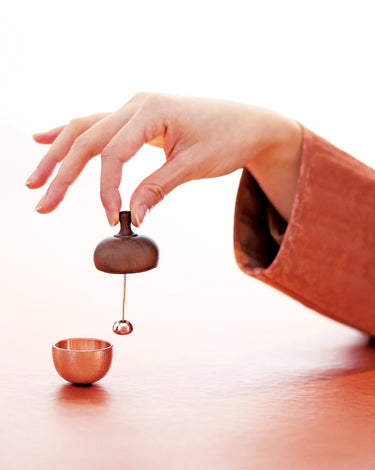
The Madoka Dongurin is the playful one: a tiny orin shaped like an acorn, about 6 centimeters tall. Instead of a mallet, a pendulum is tucked inside the wooden cap. Lift the cap and swing it, and the pendulum taps the brass bell to make a bright, clear note. KUON applied for a patent on the mechanism, and the gentle swinging motion is part of the ritual.
Brass, wood and a hand finish
Takaoka copperware usually begins as a cast: molten metal is poured into a mold, left to cool, then broken out and refined. The pieces are then turned and buff-polished on rotating cloth wheels until the surface goes from rough to mirror bright, or given a textured finish that catches the light. KUON pairs that brass with turned wood, such as the cap of the Dongurin and the bases of the Tone pieces, and each item is finished by hand, so small variations from one to the next are part of the character.

Incense and light
The Madoka series rounds out the elements. Madoka means round, or harmonious, and the pieces share a low cylindrical brass form. The Kaori holds a stick or cone of incense in a shallow dish so the smoke rises from the center. The Tomoshibi, meaning a small flame, holds a tea light so the brass glows from inside.

Meet the collection
Every KUON piece in this story can be ordered directly from LoftModern:
- Madoka Dongurin Meditation Bell: the acorn bell with a hidden pendulum
- Tone Rin Orin Bell: brass orin with a wooden mallet
- Tone Rinko Incense Burner & Orin: incense bowl that rings
- Madoka Kaori Incense Holder: brass incense dish
- Madoka Tomoshibi Candle Holder: tea light holder
See them all in our KUON collection.
Keep reading
- More Japanese craft: Mate Mono and the seamless knit bags of Ishikawa
- Gift ideas: hand-forged gifts from Japanese and Korean makers
More Japanese craft: Makoto Komatsu and the potters of Seto.
Frequently asked questions
What does KUON mean?
KUON is written 空穏, from the Japanese characters for sky and calm. The brand describes its idea simply as feeling the present moment.
Who makes KUON?
Yotsukawa Seisakusho, a copperware company founded in 1946 in Kanaya-machi, the historic casting district of Takaoka in Toyama, and run today by brothers Motomasa and Susumu Yotsukawa.
What is an orin?
An orin is a small bowl-shaped bell traditionally used on Buddhist home altars in Japan. Its long, clear tone also makes it popular for meditation and yoga.
How does the Dongurin bell work?
A small pendulum hangs inside the wooden acorn cap. Swing the cap and the pendulum strikes the brass bell to make a clear note.
Why is Takaoka known for metalwork?
Metal casters were invited to the town in 1611, and Takaoka now produces more than 90 percent of Japan's copperware.
Sources: Kogei Standard, Yotsukawa Seisakusho; Ambiente, KUON exhibitor page; Go! Go! Toyama, Kanayamachi; japan-guide.com, Kanayamachi. Photos and film courtesy of KUON / Yotsukawa Seisakusho.