Shears for the orchard, snips forged in the fire, winter slippers for the campsite and rain boots that roll up like a towel. Four Japanese makers, each solving one practical problem with unusual care.
In this story
- Tobisho: pruning and flower shears in Aogami blue steel
- Kenshi Terasaki: Tsume hand-forged grip scissors
- SUBU, Tokyo, since 2016: Nannen flame-retardant camp slippers
- Pokeboo by ATOM, Takehara, Hiroshima: packable natural rubber rain boots
Shears and nothing else
飛庄
Tobisho · shears for plants
Tobisho makes only one thing: shears for plants. Each blade is cut from Yasuki Aogami, the "blue paper" steel that Japanese smiths reserve for edges that must stay sharp, then brazed to its handle by hand. The rounded blades cut stems cleanly rather than crushing them, which is kinder to the plant, and a coiled spring opens them again after every cut. Gardeners and florists in Japan rely on them season after season.

Forged one pair at a time
握り鋏
Nigiri basami · Kenshi Terasaki
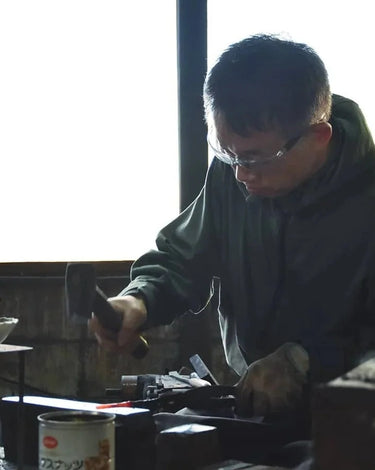
Most Japanese grip scissors, nigiri basami, begin as factory-made composite steel. Kenshi Terasaki joins iron and steel himself in the forge at around 1,000°C, then shapes each pair with a hammer, a difficult and wasteful method few smiths still use. He came to the craft late, leaving Kumamoto at 36 to train under a master in Hyogo before opening his own workshop nearby. He works by feel, to a tenth of a millimeter, and has no interest in mass production. His Tsume, meaning claw, has a short blade that meets crisply at the tip, ideal for thread, cord and fine trimming.

A winter sandal for the campfire
難燃
Nannen · flame-retardant · SUBU, Tokyo
In Japan you slip off your shoes at the door and slip on sandals for a quick trip outside, easy in summer and much less so in January. SUBU was founded in Tokyo in 2016 to make a winter sandal: a quilted upper that feels like a down jacket, a soft lining you can wear barefoot and a cushioned, multi-layer insole. The Nannen, Japanese for flame-retardant, has a CORDURA shell that resists stray sparks, so it can go from the tent to the fire and back.

Rice-paddy boots for the city
アトム
ATOM · Pokeboo · Takehara, Hiroshima
ATOM Corporation in Takehara, Hiroshima, makes work gloves and rubber boots for farmers and builders, including the thin, flexible boots worn for planting rice. Pokeboo takes that idea out of the paddy and into the city: natural rubber thin enough to roll up, a flat sole you can feel the ground through, and a carry bag with a carabiner. Japan's Good Design Award jury chose it in 2018 for how thin and compact it folds.

Shop the pieces
- Pruning Shears in Aogami Blue Steel by Tobisho
- Flower Shears in Aogami Blue Steel by Tobisho
- Tsume Hand-Forged Grip Scissors by Kenshi Terasaki
- Nannen CORDURA Camp Slippers by SUBU
- Packable Natural Rubber Rain Boots by Pokeboo
Explore more Japanese handmade craft.
Keep reading
- Gifts for the garden and kitchen: hand-forged gifts from Japanese and Korean makers
- More Japanese making: Toyo Steel and its seamless toolboxes
Frequently asked questions
What is Aogami steel?
Yasuki Aogami, or "blue paper" steel, is a Japanese carbon steel prized for edges that stay sharp. Tobisho uses it for its shear blades.
What are nigiri basami?
Japanese grip scissors that open with a spring and close with a squeeze of the hand. Kenshi Terasaki forges his by hand.
What does Nannen mean?
Flame-retardant, in Japanese. SUBU's Nannen slipper has a flame-retardant CORDURA shell for campfires.
Can Pokeboo boots really be rolled up?
Yes. They are thin natural rubber and roll into a carry bag with a carabiner.
Who makes Pokeboo?
ATOM Corporation in Takehara, Hiroshima, a maker of work gloves and rubber boots.