
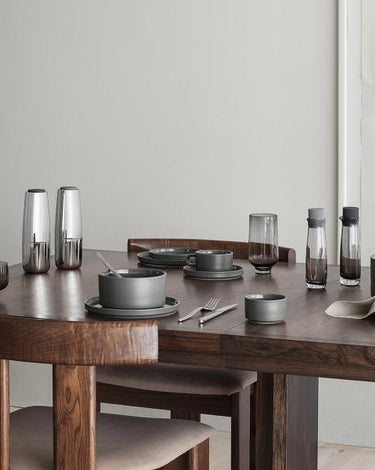
The German design house blomus (Sundern, Germany) works with a small circle of designers, and three of them shaped the dinnerware we love most. Each one drew a different answer to the same question: what should a table feel like when people sit down together? Here is who they are, how to choose between their collections, and the 18 pieces we would put on a first table.
Quick picks: which blomus collection suits my table?
| Collection | Designer | Look | Best for | Care note |
|---|---|---|---|---|
| PILAR | Nina Thöming | Matte outside, glossy glazed inside; four muted colors | Everyday family tables and open shelves | Dishwasher and microwave safe, per blomus |
| SABLO | Frederike Martens | Half glazed, half speckled bare clay | Casual dinners that invite you to linger | Rinse soon after strongly colored foods |
| MAKOTO | Carsten Gollnick | Hidden pedestal foot, Japanese-inspired, made in Portugal | A plated look; sushi and small-plate dinners | Dishwasher and microwave safe, per blomus |
| BELO | Frederike Martens | Mouth-blown glass in a tapered tulip shape | Wine and bubbles in Clear, Smoke or Coffee | Handmade: a flow line or pinpoint bubble is normal |

Who designed PILAR, SABLO and MAKOTO?
Nina Thöming: the designer who studies the need first
 Born in 1984, Nina Thöming trained as an industrial designer and works at Flöz Design in Germany, a studio blomus has relied on for many years. Her method is to study the need before drawing the answer. For PILAR she drew the plate as a shallow cylinder instead of a curved dish. That short, straight rim lets the whole family stack like a column, which is what the Spanish name means.
Frederike Martens: sand, clay and a table that makes people linger
Born in 1987 and trained in Halle, Germany, as an industrial designer focused on glass and ceramics, Frederike Martens looks for balance: quiet forms, colors picked to last, and materials allowed to show what they are. SABLO was her debut collection for blomus. She wanted a table that invites people to talk, so she took her cues from sand and clay and glazed each plate only where food sits, leaving the rest as speckled clay that feels like fine sand. Her BELO glassware is blown by mouth, one piece at a time.
Carsten Gollnick: Japanese design, one clear rule
Carsten Gollnick, born in 1966, has run his own studio in Germany since 1997 and has drawn on Japanese design for his whole career. His rule: no object outranks another, since even the smallest piece has a purpose. More than 100 products and awards from iF, the German Design Award and Red Dot have come out of that studio. For MAKOTO he gave each plate a low hidden foot that lifts it off the table so it seems to hover. MAKOTO is made in Portugal.

How do I choose between PILAR, SABLO and MAKOTO?
Choose PILAR if you want calm, stackable everyday ware. Its velvety matte shell and glossy lining wipe clean, three sizes layer into a full setting, and the four colors mix freely, so a Pewter dinner plate under a Moonbeam dessert plate looks planned.
Choose SABLO if you like texture. The two surfaces make a weekday dinner look considered. Just rinse plates soon after strongly colored foods, because the bare clay can stain.
Choose MAKOTO if you cook for an audience. The pedestal casts a soft shadow line under the rim, so even a simple meal looks plated. The matte glazes look warm in candlelight, which suits winter hosting.
How many do I need? A rule of thumb: because most pieces come in sets of four, one set each of dinner plates, pasta plates and bowls covers a first kitchen for four. Hosting six or more? Add a second set.
Which 18 blomus pieces would I start with?
PILAR by Nina Thöming


SABLO by Frederike Martens


MAKOTO by Carsten Gollnick


BELO glassware by Frederike Martens


How do I care for blomus stoneware?
According to blomus, PILAR, SABLO and MAKOTO are dishwasher and microwave safe. Firing and glazing leave small differences between pieces, so no two are exactly alike. For MAKOTO, our advice is to stack with a soft liner between plates if you keep them in a busy cupboard, to protect the matte glaze.
Why is blomus dinnerware worth the investment?
Because you will use it every day. The stoneware has the heft of clay, quartz and minerals fired hot, not the thinness of cheap ware. The shapes are drawn by designers who studied how people eat, stack and store, so they keep looking right as your kitchen changes. BELO glass is blown by hand, and MAKOTO is made in Portugal. Buy a set or two now, add pieces later, and your table grows with you instead of being replaced.
Frequently asked questions
Is blomus PILAR, SABLO or MAKOTO dishwasher safe?
According to blomus, the PILAR, SABLO and MAKOTO stoneware listed here are dishwasher and microwave safe. Firing and glazing leave small differences from piece to piece, so no two are exactly alike.
Will the bare clay on SABLO stain?
It can. Our listing advises that the bare clay can pick up stains from strongly colored foods like turmeric or red wine if left to sit, so rinse plates soon after the meal.
What is the difference between stoneware and porcelain?
Per our PILAR listing, the stoneware is cast from clay, quartz and minerals and fired hot, so it has more heft than porcelain and none of its translucency.
Can I mix PILAR, SABLO and MAKOTO on one table?
Our designer tip is to choose one finish family, such as matte stoneware, and vary the color. Within PILAR, blomus says the four colors mix freely. Mixing across collections is a styling choice rather than a rule from the maker.
Where are blomus dinnerware collections made?
blomus is a German design house based in Sundern, Germany. Our MAKOTO listings say the collection is made in Portugal; check each listing for origin details on the other pieces.
What is my next step?
Browse the full blomus collection, see how to set a holiday table, check our holiday gifts in stock, or read how to style a shelf with design objects. Not sure which set fits your space? Ask our team at LoftModern design help.