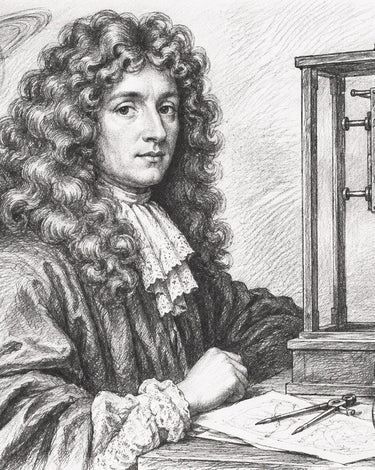
In 1656 a young Dutch scientist hung a swinging weight inside a clock and changed how the world kept time. More than three hundred and fifty years later, an Amsterdam studio named its clocks after him and took his idea one step further, into silence.
Huygens at a glance
- Namesake: Christiaan Huygens (1629–1695), the Dutch mathematician and astronomer who invented the pendulum clock in 1656 and patented it in 1657
- Huygens Amsterdam: a Dutch clock label that takes its name from him as a tribute to his pursuit of precise timekeeping
- Four series: Dome, One, Tone and Wood, all designed in the Netherlands as registered designs
- Silent sweep quartz movement: the second hand glides with no tick; one AA battery; 5-year warranty
- Shop the collection: Huygens silent wall clocks at LoftModern
Two clocks in a sickroom, The Hague, 1665
In February 1665, Christiaan Huygens was ill and confined to bed. To pass the days he watched two pendulum clocks he had recently built, hanging side by side from the same beam. Something strange happened. However he set them going, within about half an hour the two pendulums fell into step, swinging in perfect opposition, and stayed that way.
He wrote to his father about it, calling it a kind of sympathy between the clocks. He suspected tiny movements in the wood that held them, and he was right: physicists confirmed it more than three hundred years later. It was the first recorded observation of what science now calls synchronization. It also tells you something about the man. Even flat on his back, he could not stop looking closely at the instrument he had invented.
Who was Christiaan Huygens?
Huygens was born in The Hague on 14 April 1629, the second son of Constantijn Huygens, a diplomat, poet and secretary to the Princes of Orange. The house was full of visitors from the intellectual life of the Dutch Golden Age, and René Descartes, a friend of the family, praised the boy's gift for geometry.
He studied law and mathematics at Leiden and then at the new College of Orange in Breda. His father hoped he would become a diplomat. Instead he stayed home in The Hague and gave himself to research: he ground his own telescope lenses, discovered Titan, Saturn's largest moon, in 1655, and worked out the true shape of Saturn's rings. He went on to describe light as a wave, an idea still taught today. Yet of everything he made, the invention that reached into ordinary homes was a clock.
December 1656: the pendulum takes charge of the clock
Before Huygens, even good clocks could drift by around a quarter of an hour a day. Galileo had seen that a swinging pendulum keeps a steady beat, but he never finished a clock built around it. Huygens did. Toward the end of 1656 he designed a clock in which a pendulum regulated the movement, and the result was astonishing for its time: drift of roughly fifteen seconds a day instead of fifteen minutes.
Huygens was a scientist, not a clockmaker, so he entrusted the building to Salomon Coster, a clockmaker in The Hague. On 16 June 1657 Huygens obtained the patent, and Coster began making the clocks under licence. The oldest surviving pendulum clock in the world carries the inscription Salomon Coster Haghe met privilege 1657, Coster of The Hague, by privilege, and it is kept today at the Rijksmuseum Boerhaave in Leiden. Within a year the London clockmaking family Fromanteel had sent a son to Coster's workshop, and pendulum clocks were being advertised in London by November 1658. Across Baroque Europe, homes and towers began to keep the same, far truer time.

Horologium Oscillatorium and the race for longitude
Huygens kept refining the idea for the rest of his life. He described his clock in a short book, Horologium, in 1658. In 1673 he published Horologium Oscillatorium, his great treatise on the pendulum. In it he showed that wide swings make a pendulum less reliable, and he worked out the curved path that would keep its beat constant.
He also chased the biggest timekeeping prize of the age: finding longitude at sea, which needs a clock that keeps true time on a rolling ship. His marine pendulum clocks went to sea on trials in 1662 and 1686 with mixed results. Around 1675 he turned to a spiral balance spring for a pocket watch, the same principle that still sits at the heart of mechanical watches. Pendulum clocks went on to dominate precise timekeeping until the quartz clock appeared in 1927.

From the swing of a pendulum to a silent sweep
Every pendulum clock speaks in a tick. The sound comes from the escapement, the small catch that lets the gears move forward one step at a time, paced by the swing. For nearly three hundred years that tick was the voice of accuracy.
The Amsterdam studio behind Huygens clocks chose its name as a tribute to the man who made clocks trustworthy, and then removed the one thing his invention always brought with it: the sound. Each clock runs on a silent sweep quartz movement. There is no stepping second hand and no tick, only a continuous glide around the dial. It keeps the precision Huygens fought for and gives back the quiet, which is why these clocks are as comfortable in a bedroom or a study as on a kitchen wall.
The design follows the same thinking. Huygens valued clarity above ornament in his work, and the modern collection is pared back in that spirit: a clear face, slim hands, one small accent of color, and nothing that does not help you read the time.
Four faces, one line of descent
Dome. A convex glass lens over a white dial recalls the station and schoolroom clocks that kept public time for generations. It comes with Arabic numerals or slim index markers. See the Dome Silent Wall Clock with Convex Glass.
One. A ring of brushed stainless steel around a crisp index dial, with a red-orange center. It is the purest of the four, closer to a fine wristwatch scaled up for the wall: the One Silent Wall Clock in Brushed Stainless Steel.

Tone. Black on black. The matte dial carries index markers printed in gloss varnish, so they appear and disappear as the light moves across the room, a tone-on-tone play that rewards a second look: the Tone Silent Wall Clock.

Wood. A thin frame of bent plywood brings warmth and natural grain to the classic white dial, the most domestic of the four: the Wood Silent Wall Clock with Bent Plywood Frame.

How the clocks are made
Every Huygens clock is designed in the Netherlands and protected as a registered design. According to the brand, each one is tested to its quality standards before it ships and is made from recyclable materials. Inside is a silent sweep quartz movement powered by a single AA battery, and the clocks carry a 5-year warranty against defects in materials and workmanship. The cases are kept slim, 4.6 cm deep for the smallest size and 6.2 cm for the larger ones, so they sit close to the wall like a framed picture.
It is a quiet kind of homage. Huygens spent his life making time more exact. The clocks that carry his name keep that exactness and simply let the room stay still.
Meet the collection
Every Huygens clock in this story is available to order directly from LoftModern:
- Dome Silent Wall Clock with Convex Glass: domed glass, Arabic or index dial, 13.8" or 17.7"
- One Silent Wall Clock in Brushed Stainless Steel: brushed steel ring, index dial, 13.8" or 17.7"
- Tone Silent Wall Clock, Black Ton-sur-Ton Dial: matte black with gloss markers, 9.8" or 13.8"
- Wood Silent Wall Clock with Bent Plywood Frame: bent plywood rim, 9.8" to 17.7"
Browse the full Huygens collection or all designer clocks.
Keep reading
- Another Amsterdam story: how APE Amsterdam designed the Humble cordless lamp
- More timepieces with design pedigree: Braun watches and clocks as gifts
- Good form across Europe: Max Bill, Wohnbedarf Zurich and the furniture of good form
- A quiet desk: how to set up a desk lamp for a home office
Frequently asked questions
Why is the clock brand called Huygens?
It is named after Christiaan Huygens, the Dutch scientist who invented the pendulum clock in 1656. The Amsterdam brand carries his name as a tribute to his pursuit of precise timekeeping.
What did Christiaan Huygens invent?
The pendulum clock, designed in 1656 and patented on 16 June 1657, which made clocks around sixty times more accurate. He also developed the spiral balance spring for watches, discovered Saturn's moon Titan and proposed the wave theory of light.
Did Huygens build his clocks himself?
No. He designed them and licensed the clockmaker Salomon Coster of The Hague to build them. Coster's 1657 clock, the oldest surviving pendulum clock, is in the Rijksmuseum Boerhaave in Leiden.
Do Huygens clocks tick?
No. Unlike the pendulum clocks of Huygens' day, they use a silent sweep quartz movement, so the second hand glides continuously with no ticking sound.
Where are Huygens clocks designed?
In the Netherlands. Every model is a registered design and, according to the brand, is tested to its quality standards and made from recyclable materials.
Sources: Huygens Amsterdam; APS News, June 16, 1657: Christiaan Huygens patents the first pendulum clock; The Metropolitan Museum of Art, Heilbrunn Timeline: European clocks; Guinness World Records, oldest pendulum clock; Pikovsky, Rosenblum and Kurths, Synchronization (Cambridge University Press), Huygens' 1665 letters; specifications from our product listings. Header image: a pen-and-ink sketch of Christiaan Huygens with an early pendulum clock (modern illustration, not a period likeness). Clock photos courtesy of Huygens.